Languages
C++ Mastery
Memory, pointers, templates, the STL and modern C++ explained with small examples.
- Handwritten-style
- Diagrams and tables
- Worked examples
Who this notebook is for
Students and developers preparing for C++ interviews, and anyone who finds pointers, references and templates confusing. It explains each idea with a small picture first.
What you will be able to do
- Explain stack, heap, pointers and references with a memory diagram
- Use smart pointers and RAII to avoid leaks
- Write and read simple templates and use the STL containers and algorithms
- Describe move semantics and when the compiler uses them
What's inside
Pick a chapter and the notebook opens right there.
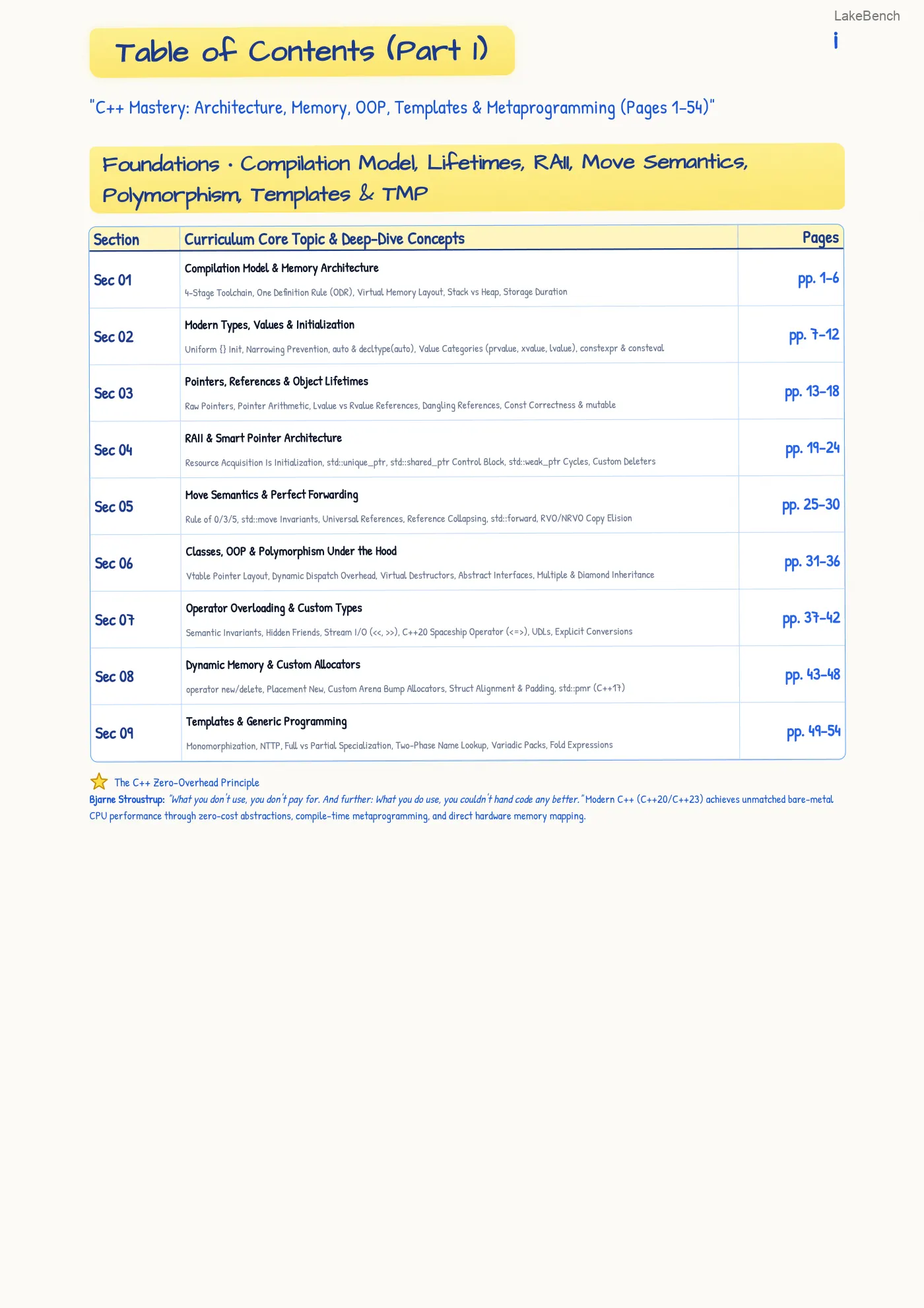
- Compilation Model & Memory Architecture4-Stage Toolchain, One Definition Rule (ODR), Virtual Memory Layout, Stack vs Heap, Storage DurationStart here
- Modern Types, Values & InitializationUniform {} Init, Narrowing Prevention, auto & decltype(auto), Value Categories (prvalue, xvalue, lvalue), constexpr & constevalStart here
- Pointers, References & Object LifetimesRaw Pointers, Pointer Arithmetic, Lvalue vs Rvalue References, Dangling References, Const Correctness & mutableStart here
- RAII & Smart Pointer ArchitectureResource Acquisition Is Initialization, std::unique_ptr, std::shared_ptr Control Block, std::weak_ptr Cycles, Custom DeletersStart here
- Move Semantics & Perfect ForwardingRule of 0/3/5, std::move Invariants, Universal References, Reference Collapsing, std::forward, RVO/NRVO Copy ElisionStart here
- Classes, OOP & Polymorphism Under the HoodVtable Pointer Layout, Dynamic Dispatch Overhead, Virtual Destructors, Abstract Interfaces, Multiple & Diamond InheritanceStart here
- Operator Overloading & Custom TypesSemantic Invariants, Hidden Friends, Stream I/O (<<, >>), C++20 Spaceship Operator (<=>), UDLs, Explicit ConversionsStart here
- Dynamic Memory & Custom Allocatorsoperator new/delete, Placement New, Custom Arena Bump Allocators, Struct Alignment & Padding, std::pmr (C++17)Start here
- Templates & Generic ProgrammingMonomorphization, NTTP, Full vs Partial Specialization, Two-Phase Name Lookup, Variadic Packs, Fold ExpressionsStart here
- Compile-Time Metaprogramming & ConceptsTuring-Complete TMP, Type Traits Library, SFINAE & void_t, if constexpr, C++20 Concepts & Subsumption RulesStart here
- STL Containers: Sequences & Adaptorsvector Geometric Growth, array & deque Chunked Pages, list Cache Miss Penalties, Adaptors, Invalidation RulesStart here
- STL Associative & Unordered ContainersRed-Black Tree Invariants, Hash Table Chaining & Rehashing, Custom Hasher & Equality, C++23 Flat ContainersStart here
- STL Algorithms, Iterators & RangesIterator Categories, No Raw Loops, Introsort & Quickselect, C++20 Ranges & Views Pipe (|), Parallel PoliciesStart here
- Exceptions & Modern Error HandlingZero-Cost Itanium ABI, Stack Unwinding, Exception Safety Guarantees, noexcept Optimizations, std::expected (C++23)Start here
- Concurrency & C++ Memory Modelstd::jthread & stop_token, std::scoped_lock Deadlock Avoidance, Condition Variables, std::atomic & Memory Ordering, Lock-Free SPSCStart here
- Modern C++ Standards (17 / 20 / 23)Structured Bindings, C++20 Modules (10x Build Acceleration), Coroutines (co_await), std::span & string_view, std::format, SSOStart here
- Performance, Profiling & Systems C++CPU L1/L2/L3 Latencies, Branch Prediction [[likely]], SoA vs AoS SIMD, Compiler Inlining/RVO, Sanitizers (ASan/TSan), UB TrapsStart here
- Top 30 FAANG Technical Interview DrillsDrills 1–30: Object Slicing, Move Traps, Lock-Free Ring Buffer, High-Throughput Object Pool & Principal Engineer ChecklistStart here
Practice this
Put it to work on LakeBench.
Common questions
- Do I need to know C before this notebook?
- No. It starts from how a C++ program is compiled and how memory is laid out, then adds one feature at a time.
- Does it use modern C++?
- Yes. It covers move semantics, smart pointers, concepts and ranges as well as the older features.
- Can I read a sample before I commit?
- Yes. The contents pages and the first pages of every notebook can be read online, so you can judge the style before going further.