CS fundamentals
Computer Networks
From the OSI model to TCP, DNS, routing and web protocols, one layer at a time.
- Handwritten-style
- Diagrams and tables
- Worked examples
Who this notebook is for
Students and freshers preparing for networking questions, and developers who want to understand what happens between a browser and a server.
What you will be able to do
- Walk through what happens when you type a web address and press enter
- Do IPv4 subnetting and CIDR questions by hand
- Explain the TCP handshake, retransmission and congestion control
- Describe how DNS, HTTP and TLS fit on top of the lower layers
What's inside
Pick a chapter and the notebook opens right there.
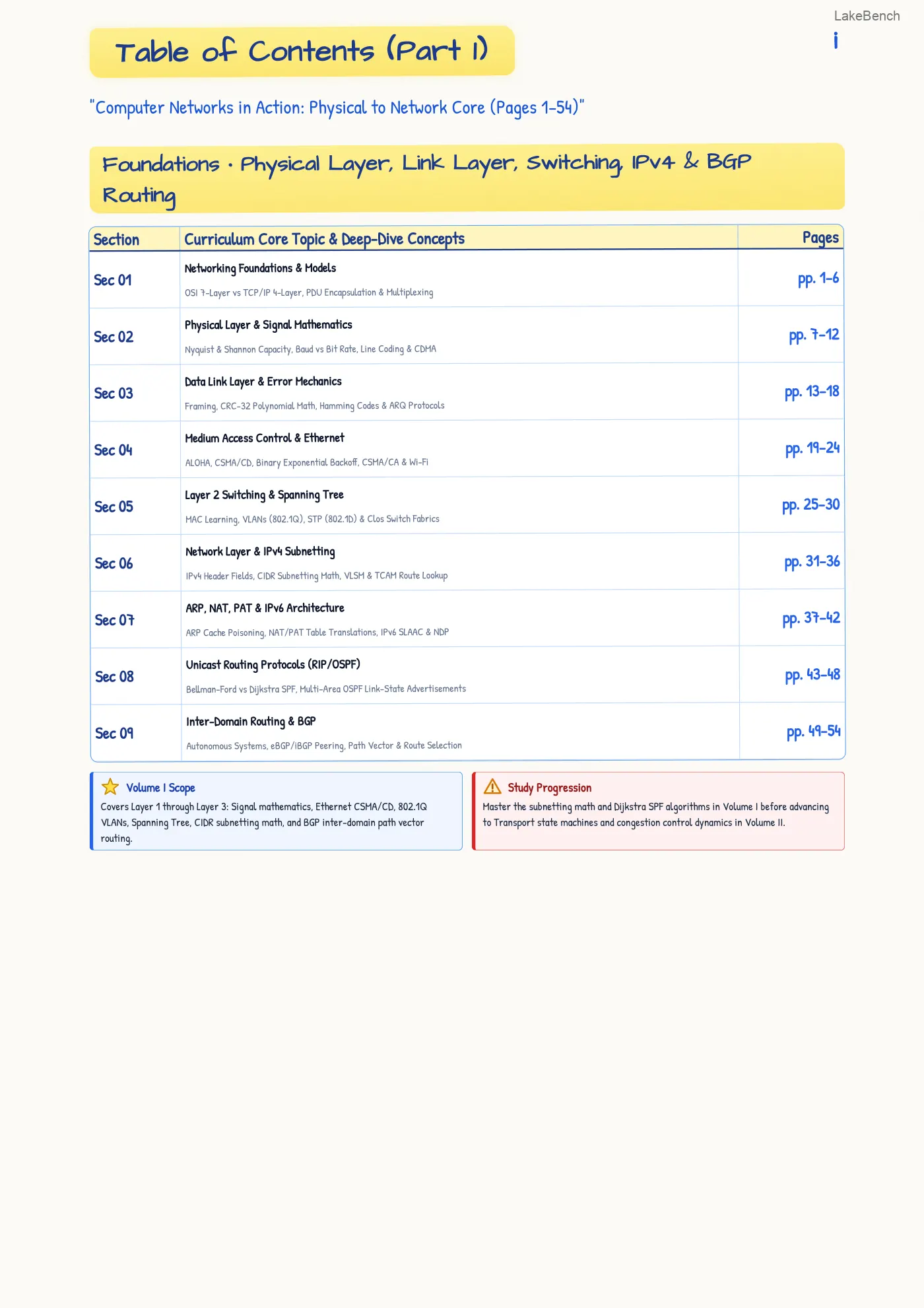
- Networking Foundations & ModelsOSI 7-Layer vs TCP/IP 4-Layer, PDU Encapsulation & MultiplexingStart here
- Physical Layer & Signal MathematicsNyquist & Shannon Capacity, Baud vs Bit Rate, Line Coding & CDMAStart here
- Data Link Layer & Error MechanicsFraming, CRC-32 Polynomial Math, Hamming Codes & ARQ ProtocolsStart here
- Medium Access Control & EthernetALOHA, CSMA/CD, Binary Exponential Backoff, CSMA/CA & Wi-FiStart here
- Layer 2 Switching & Spanning TreeMAC Learning, VLANs (802.1Q), STP (802.1D) & Clos Switch FabricsStart here
- Network Layer & IPv4 SubnettingIPv4 Header Fields, CIDR Subnetting Math, VLSM & TCAM Route LookupStart here
- ARP, NAT, PAT & IPv6 ArchitectureARP Cache Poisoning, NAT/PAT Table Translations, IPv6 SLAAC & NDPStart here
- Unicast Routing Protocols (RIP/OSPF)Bellman-Ford vs Dijkstra SPF, Multi-Area OSPF Link-State AdvertisementsStart here
- Inter-Domain Routing & BGPAutonomous Systems, eBGP/iBGP Peering, Path Vector & Route SelectionStart here
- Transport Layer & UDP InternalsUDP Header Anatomy, Pseudo-Header Checksum, WebRTC & UDP SocketsStart here
- TCP Handshake & State Machine3-Way Handshake, SYN Cookies, 4-Way Teardown, 11-State TCP FSMStart here
- TCP Reliability & Sliding WindowGo-Back-N vs SR, Flow Control rwnd, Jacobon's RTO, SACK & Fast RetransmitStart here
- TCP Congestion Control & AlgorithmsAIMD, Slow Start, ssthresh, Tahoe vs Reno, TCP CUBIC, Google BBR & ECNStart here
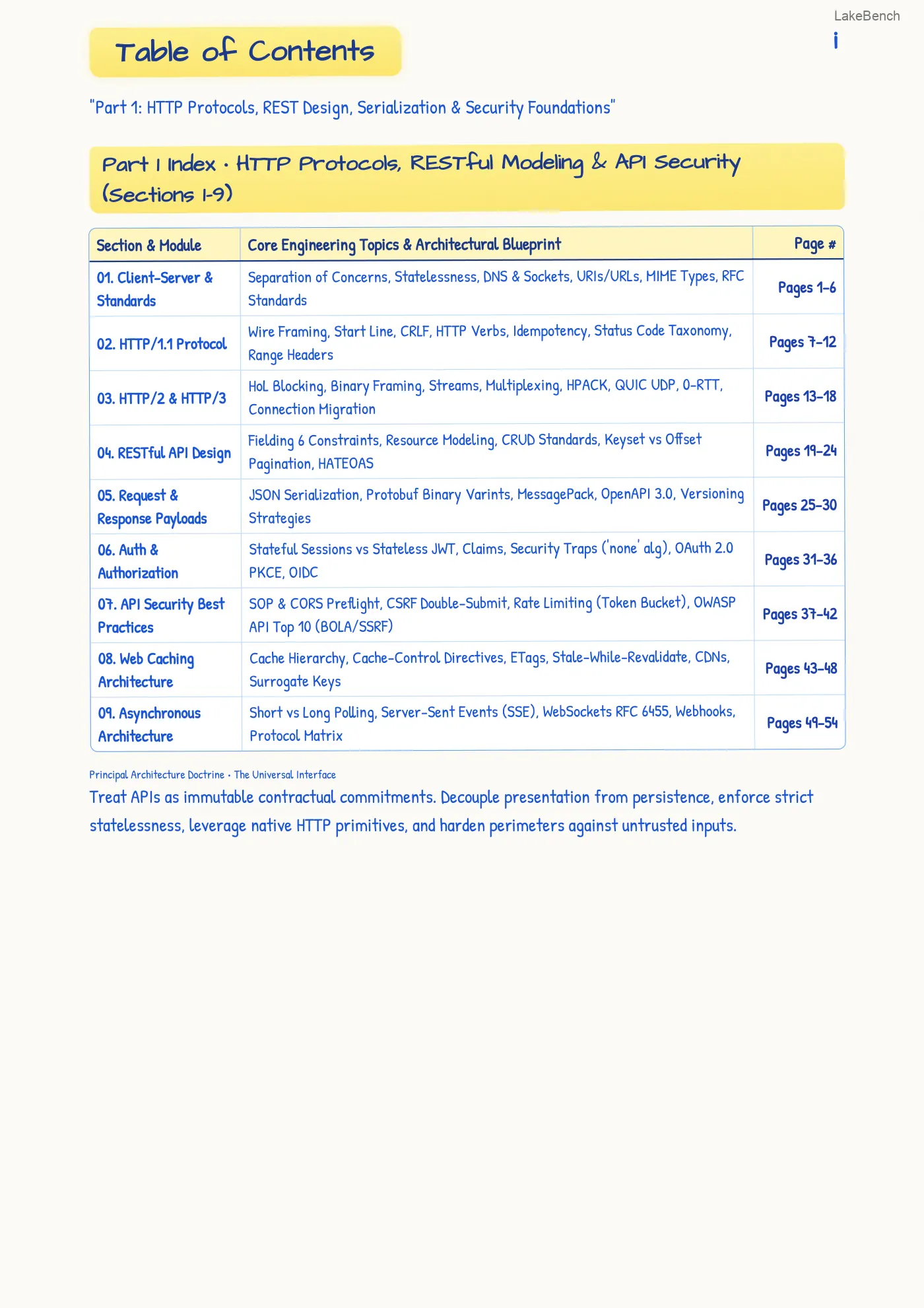
- Application Layer & Domain Name SystemRoot Server Topology, Recursive vs Iterative DNS, DNSSEC, DoH & GSLBStart here
- Modern Web Protocols (HTTP/1 to HTTP/3)HTTP/1.1 HoL, HTTP/2 Binary Framing & HPACK, HTTP/3 QUIC over UDPStart here
- Network Security & CryptographyAES-GCM, Diffie-Hellman / ECDHE, X.509 PKI, TLS 1.3, SSH & WireGuardStart here
- Socket Programming & Linux DiagnosticsBerkeley C Sockets, epoll Event Loop, tcpdump, ss, curl & Triage FlowchartStart here
- FAANG Interview Drills & Cheat SheetMath Formulae, 'What happens on google.com', TIME_WAIT, PMTU & Top 15 Q&AStart here
Practice this
Put it to work on LakeBench.
Common questions
- Is this notebook only for exam preparation?
- No. It is written to explain how networks really work, and it also ends with interview drills, so it serves both exams and real jobs.
- Do I need a networking background?
- No. It starts with the layered model and builds up one layer at a time.
- Can I read a sample before I commit?
- Yes. The contents pages and the first pages of every notebook can be read online, so you can judge the style before going further.