CS fundamentals
DBMS Theory
Relational model, normalization, indexing, transactions and recovery, the DBMS questions interviews repeat.
- Handwritten-style
- Diagrams and tables
- Worked examples
Who this notebook is for
Students and freshers preparing for database questions in placements, and developers who want to know what a database does underneath SQL.
What you will be able to do
- Find keys and functional dependencies and normalize a table to BCNF
- Explain how a B+ tree index speeds up a query
- Describe ACID, isolation levels and how locking and MVCC work
- Read a query plan and say why one join order beats another
What's inside
Pick a chapter and the notebook opens right there.
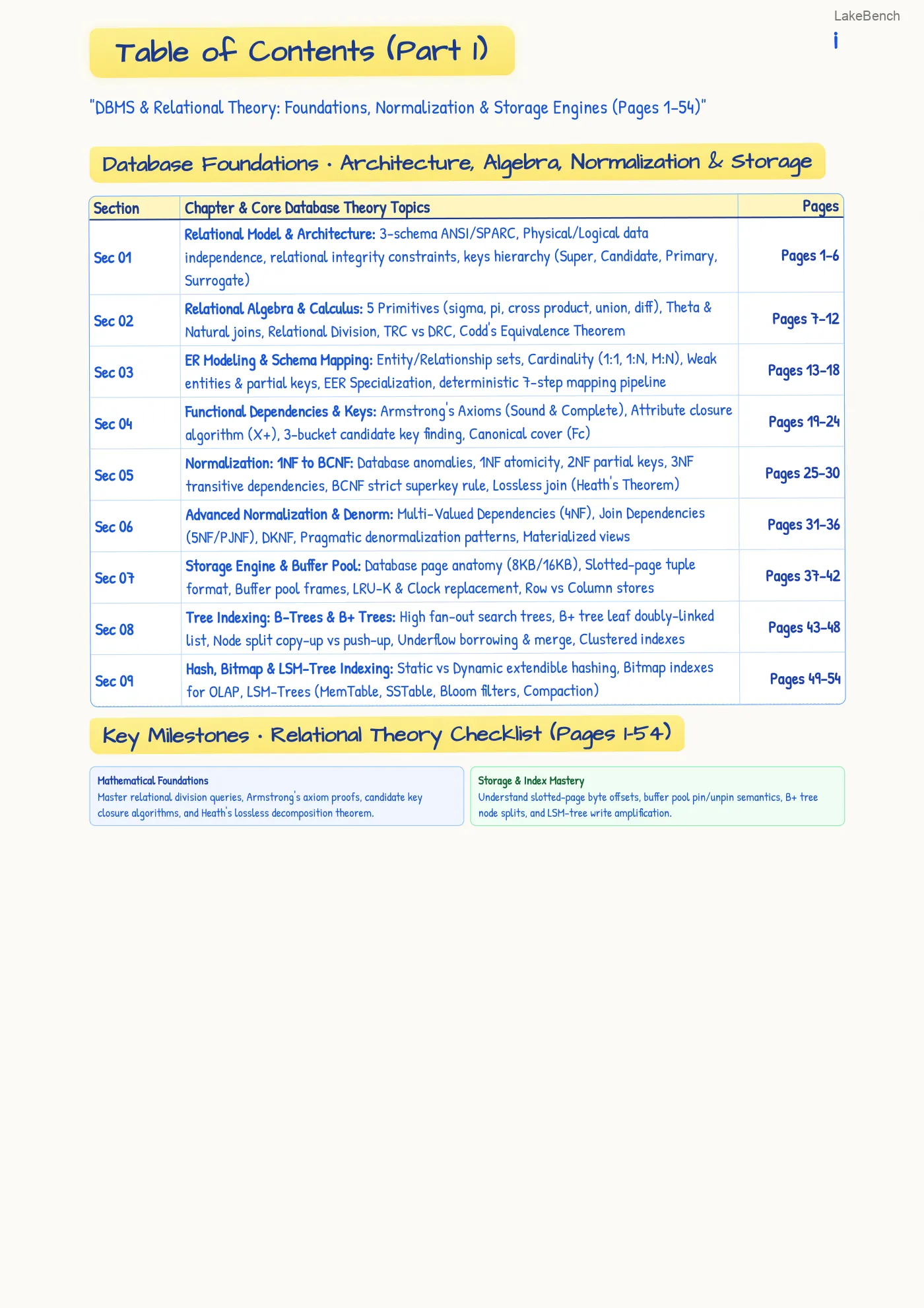
- Relational Model & Architecture3-schema ANSI/SPARC, Physical/Logical data independence, relational integrity constraints, keys hierarchy (Super, Candidate, Primary, Surrogate)Start here
- Relational Algebra & Calculus5 Primitives (sigma, pi, cross product, union, diff), Theta & Natural joins, Relational Division, TRC vs DRC, Codd's Equivalence TheoremStart here
- ER Modeling & Schema MappingEntity/Relationship sets, Cardinality (1:1, 1:N, M:N), Weak entities & partial keys, EER Specialization, deterministic 7-step mapping pipelineStart here
- Functional Dependencies & KeysArmstrong's Axioms (Sound & Complete), Attribute closure algorithm (X+), 3-bucket candidate key finding, Canonical cover (Fc)Start here
- Normalization: 1NF to BCNFDatabase anomalies, 1NF atomicity, 2NF partial keys, 3NF transitive dependencies, BCNF strict superkey rule, Lossless join (Heath's Theorem)Start here
- Advanced Normalization & DenormMulti-Valued Dependencies (4NF), Join Dependencies (5NF/PJNF), DKNF, Pragmatic denormalization patterns, Materialized viewsStart here
- Storage Engine & Buffer PoolDatabase page anatomy (8KB/16KB), Slotted-page tuple format, Buffer pool frames, LRU-K & Clock replacement, Row vs Column storesStart here
- Tree Indexing: B-Trees & B+ TreesHigh fan-out search trees, B+ tree leaf doubly-linked list, Node split copy-up vs push-up, Underflow borrowing & merge, Clustered indexesStart here
- Hash, Bitmap & LSM-Tree IndexingStatic vs Dynamic extendible hashing, Bitmap indexes for OLAP, LSM-Trees (MemTable, SSTable, Bloom filters, Compaction)Start here
- Query Processing & Join AlgorithmsVolcano iterator model, Block Nested Loop, Sort- Merge Join, Grace Hash Join 3(M+N) cost derivation, Broadcast vs Shuffle joinsStart here
- Query Optimization & EXPLAINCost-Based Optimizer (CBO), Selinger dynamic programming, Equi-depth histograms, EXPLAIN ANALYZE interpretation, Parameter sniffingStart here
- Transactions & ACID PropertiesTransaction lifecycle, STEAL/NO-FORCE buffer policies, WAL invariants, ANSI isolation phenomena (Dirty, Fuzzy, Phantom reads)Start here
- Concurrency & SerializabilityConflict serializability & precedence graphs, View serializability & blind writes, Cascading vs Cascadeless vs Strict schedules, OCCStart here
- Two-Phase Locking & DeadlocksGrowing & shrinking phases, Strict 2PL, Multiple Granularity Locking (IS, IX, SIX), Wait-For Graphs, Wait-Die vs Wound-Wait, Next-Key locksStart here
- MVCC & Snapshot IsolationReaders never block writers, xmin/xmax tuple headers, Read Views, PostgreSQL VACUUM & table bloat, TxID wraparound, SSI write skewStart here
- Crash Recovery & The ARIES AlgorithmFuzzy checkpointing, ARIES 3 passes (Analysis, Redo, Undo), Repeating history, Compensation Log Records (CLRs), Crash during recoveryStart here
- Distributed DBs, Replication & CAPSharding & Consistent Hashing, Primary-Replica, Two- Phase Commit (2PC), Paxos & Raft consensus, CAP Theorem & PACELC, Spanner TrueTimeStart here
- FAANG DBMS Drills & Master Cheat SheetTop 10 High-frequency interview drills, mathematical formula cheat sheet, SQL tuning rules, system diagnostic views, readiness matrixStart here
Practice this
Put it to work on LakeBench.
Common questions
- How is this different from learning SQL?
- SQL is the language. This notebook is the theory behind it: how tables are designed, stored, indexed and kept correct when many users write at once.
- Does it help with the DBMS questions freshers get asked?
- Yes. It covers keys, normalization, transactions and indexes in the order interviews ask them, with a drills chapter at the end.
- Can I read a sample before I commit?
- Yes. The contents pages and the first pages of every notebook can be read online, so you can judge the style before going further.