Foundations
Data Modeling: The Visual Notebook
Facts, dimensions, star schemas and slowly changing data, drawn rather than described.
- Handwritten-style
- Diagrams and tables
- Worked examples
Who this notebook is for
Anyone who has to design tables for analytics, and candidates facing data modeling rounds who want the diagrams in their head.
What you will be able to do
- Draw an entity model and set the right cardinality between tables
- Normalize a design step by step and explain each normal form
- Build a star schema and choose the grain of a fact table
- Handle changing data with slowly changing dimensions and understand Data Vault
What's inside
Pick a chapter and the notebook opens right there.
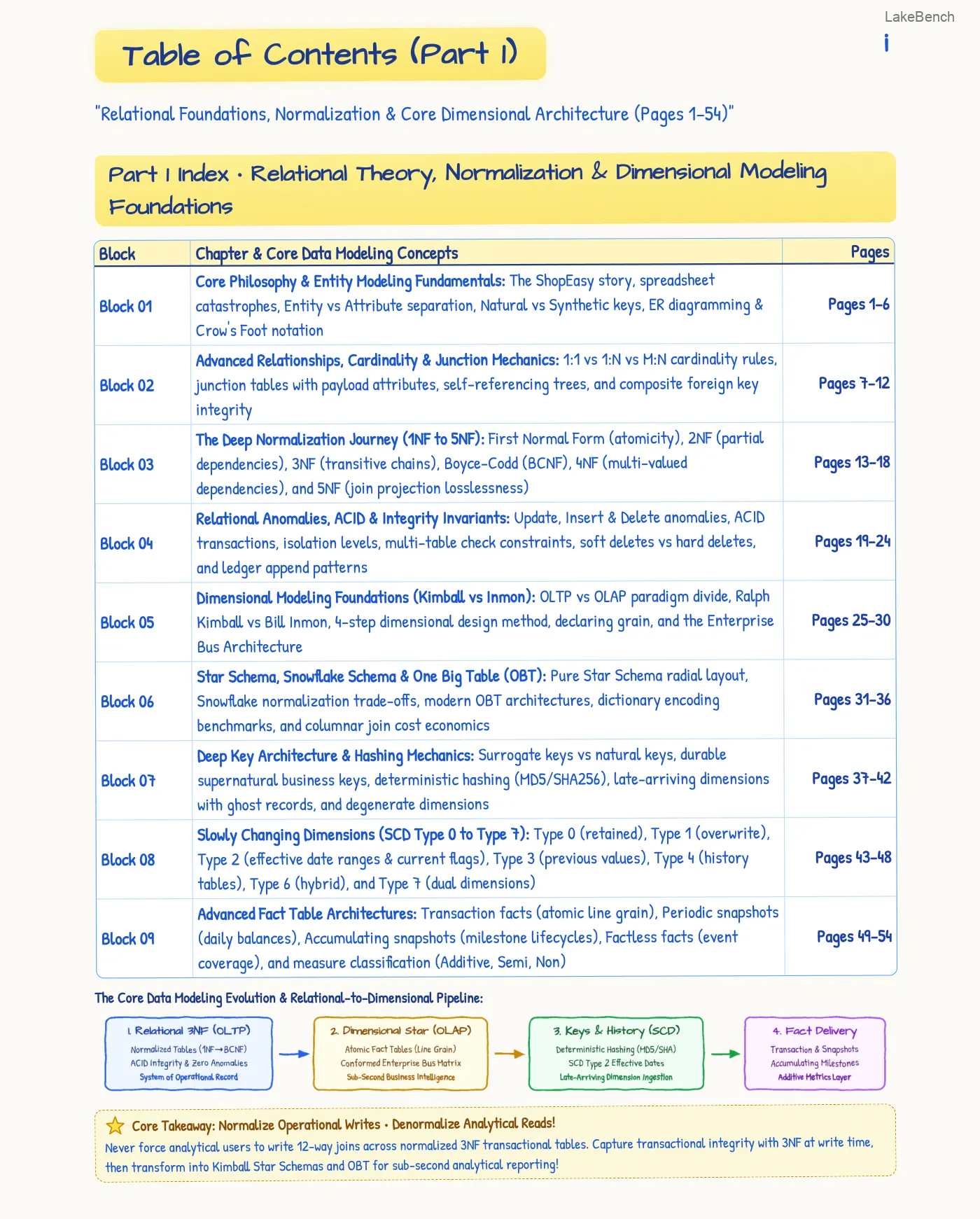
- Core Philosophy & Entity Modeling FundamentalsThe ShopEasy story, spreadsheet catastrophes, Entity vs Attribute separation, Natural vs Synthetic keys, ER diagramming & Crow's Foot notationStart here
- Advanced Relationships, Cardinality & Junction Mechanics1:1 vs 1:N vs M:N cardinality rules, junction tables with payload attributes, self-referencing trees, and composite foreign key integrityStart here
- The Deep Normalization Journey (1NF to 5NF)First Normal Form (atomicity), 2NF (partial dependencies), 3NF (transitive chains), Boyce-Codd (BCNF), 4NF (multi-valued dependencies), and 5NF (join projection losslessness)Start here
- Relational Anomalies, ACID & Integrity InvariantsUpdate, Insert & Delete anomalies, ACID transactions, isolation levels, multi-table check constraints, soft deletes vs hard deletes, and ledger append patternsStart here
- Dimensional Modeling Foundations (Kimball vs Inmon)OLTP vs OLAP paradigm divide, Ralph Kimball vs Bill Inmon, 4-step dimensional design method, declaring grain, and the Enterprise Bus ArchitectureStart here
- Star Schema, Snowflake Schema & One Big Table (OBT)Pure Star Schema radial layout, Snowflake normalization trade-offs, modern OBT architectures, dictionary encoding benchmarks, and columnar join cost economicsStart here
- Deep Key Architecture & Hashing MechanicsSurrogate keys vs natural keys, durable supernatural business keys, deterministic hashing (MD5/SHA256), late-arriving dimensions with ghost records, and degenerate dimensionsStart here
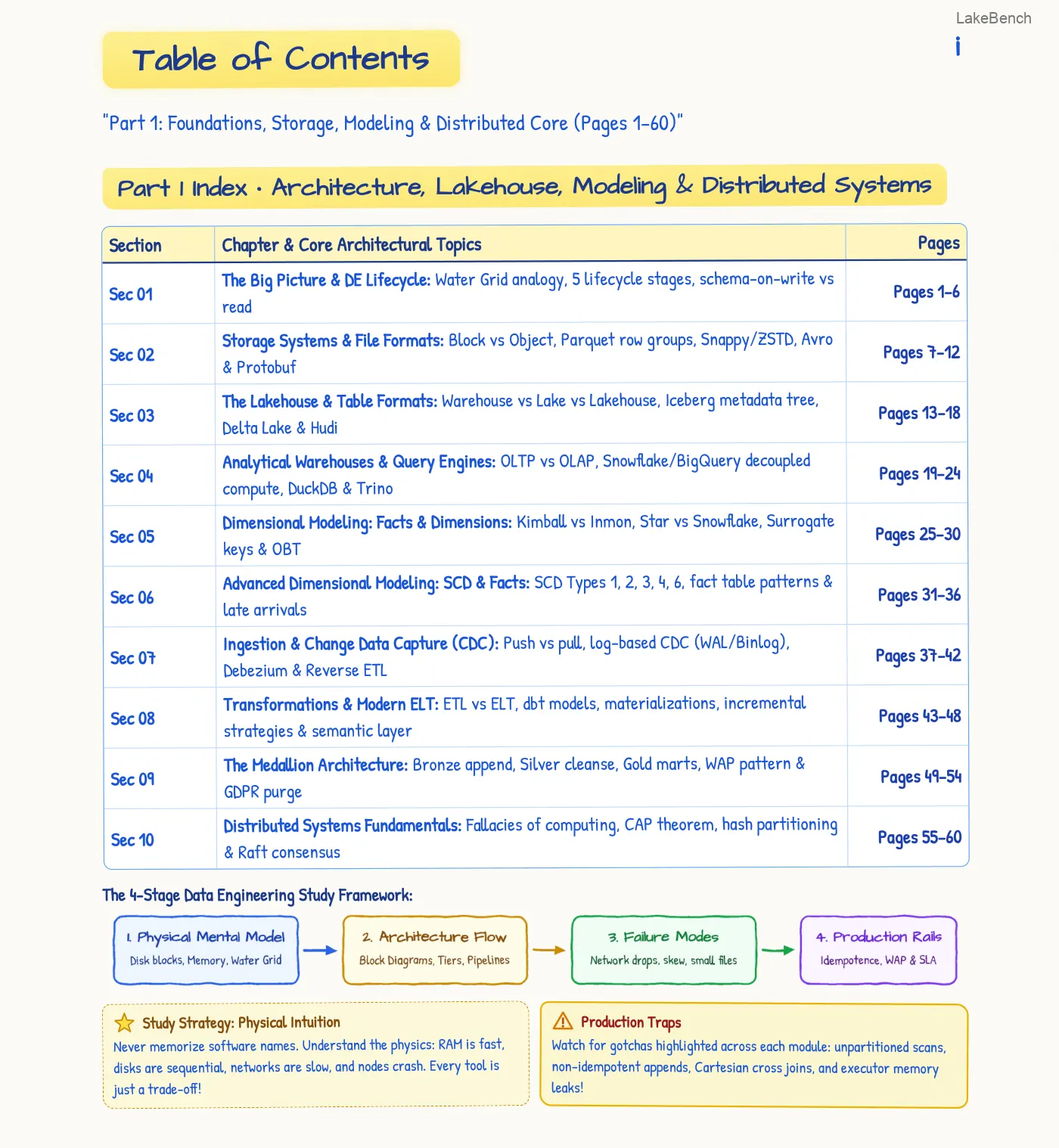
- Slowly Changing Dimensions (SCD Type 0 to Type 7)Type 0 (retained), Type 1 (overwrite), Type 2 (effective date ranges & current flags), Type 3 (previous values), Type 4 (history tables), Type 6 (hybrid), and Type 7 (dual dimensions)Start here
- Advanced Fact Table ArchitecturesTransaction facts (atomic line grain), Periodic snapshots (daily balances), Accumulating snapshots (milestone lifecycles), Factless facts (event coverage), and measure classification (Additive, Semi, Non)Start here
- Advanced Dimension Modeling & HierarchiesConformed dimensions & enterprise bus matrix, role-playing dimensions, junk dimensions (consolidating flags), outrigger dimensions, ragged parent-child bridge tables, and weighted bridge tablesStart here
- Modern Lakehouse & Cloud Warehouse ModelingMedallion architecture (Bronze/Silver/Gold), BigQuery STRUCT & ARRAY nested records, semi-structured JSON vs Parquet shredding, Delta Lake & Iceberg table formats, and dbt patternsStart here
- Graph & Document Data ModelingParadigm shift (Relational vs Document vs Graph), embedding vs referencing rules, bucket & subset patterns, Labeled Property Graphs, index- free adjacency, and polyglot persistenceStart here
- Temporal & Bitemporal Data ModelingValid Time (business) vs Transaction Time (system), bitemporal 2D matrix, SQL:2011 temporal standard, retroactive interval splitting, point-in- time range joins, and regulatory audit non-repudiationStart here
- Data Vault 2.0 ArchitectureHubs (business keys), Links (natural transactions), Satellites (descriptive context & hash diffs), zero-dependency parallel ingestion via MD5/SHA256, Point-in-Time (PIT) tables, and Kimball-on-Vault martsStart here
- Physical Performance Optimization & Storage LayoutRow stores vs Columnar formats (Parquet), partitioning mechanics (Range, Hash, List), clustering & Z-Order curves, Databricks Liquid Clustering, vectorized read pruning, and salting data skewStart here
- Staff FAANG Data Modeling System DrillsOmnichannel retail fulfillment (Amazon), real- time ride dispatch & H3 spatial surge (Uber), double-entry financial ledger (Stripe), streaming session feature store (Netflix), and IoT fleet telemetry (Tesla)Start here
- Enterprise Architecture, Anti-Patterns & Master CheatsheetTop 10 deadly data modeling anti-patterns, Data Mesh & semantic layer architecture, the 5-step Staff interview defense blueprint, and the Master 100-Point Certification CheatsheetStart here
- Modern Semantic Layer, Activity Schema & Vector ModelingDecoupled metrics (MetricFlow), 11-column activity stream, vector embeddings (HNSW) & Data Mesh data productsStart here
- Gap-Fill SupplementFact constellation & anchor modeling, wide-column & time-series, event modeling, schema registry, CQRSStart here
Practice this
Put it to work on LakeBench.
Read the guide first
Short explainers that pair with this notebook.
- SCD Type 2 explained with SQL: keep the history when a customer changes city
- Star schema vs snowflake schema: the same report built both ways
- Database normalization explained for beginners: 1NF, 2NF and 3NF with SQL
- Primary key vs foreign key explained for beginners, with SQL examples
- OLTP vs OLAP explained for beginners, with SQL examples
Common questions
- Is it about Kimball or Inmon?
- Both. It compares the two approaches and then goes into star schemas, snowflake schemas, one big table designs and Data Vault.
- Does it include interview practice?
- Yes. A chapter of system-style modeling drills and a master cheat sheet close the book.
- Can I read a sample before I commit?
- Yes. The contents pages and the first pages of every notebook can be read online, so you can judge the style before going further.