
pandasintermediate45 minPandas
IoT Sensor Telemetry Resampling and Imputation
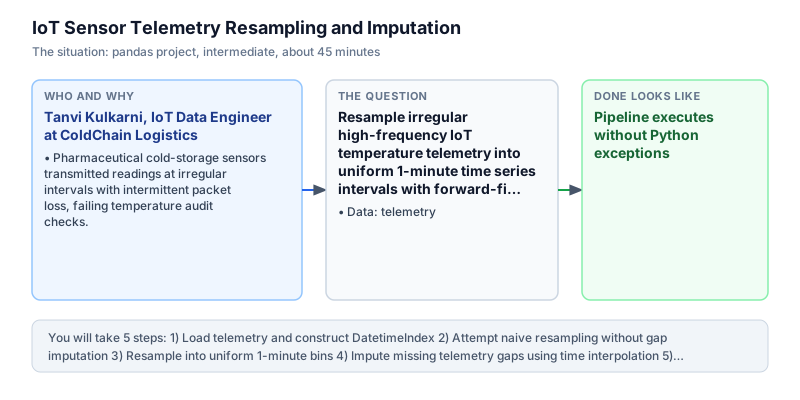
Resample irregular high-frequency IoT temperature telemetry into uniform 1-minute time series intervals with forward-fill and interpolation in Pandas.
The incident
- Company
- ColdChain Logistics
- Engineer
- Tanvi Kulkarni, IoT Data Engineer
- Trigger
- Pharmaceutical cold-storage sensors transmitted readings at irregular intervals with intermittent packet loss, failing temperature audit checks.
- Stakes
- Over 25 lakh rupees in temperature-sensitive vaccine shipments risked regulatory quarantine if continuous 1-minute compliance logs could not be proven.
On a Wednesday morning, Tanvi Kulkarni was summoned to an emergency compliance review at ColdChain Logistics, a temperature-controlled pharmaceutical freight provider. A refrigerated cargo container carrying 25 lakh rupees worth of temperature-sensitive vaccines had arrived at an international distribution hub. Port health regulators demanded continuous 1-minute temperature logs proving the shipment had maintained temperatures between 2.0 and 8.0 degrees Celsius throughout transit.
However, the container onboard cellular IoT sensors transmitted telemetry packets at erratic intervals ranging from 12 seconds to 90 seconds due to weak coastal satellite connectivity. Several transmission dropouts left entire minutes without recorded data. The regulatory audit software rejected the raw telemetry file, citing non-continuous timestamp sequences and threatening immediate shipment quarantine. Port officials refused to accept fragmented sensor logs, and shipping insurers warned that missing intervals would invalidate cargo spoilage policies.
The warehouse operations team was on the verge of writing off the shipment. Tanvi recognized that the underlying sensor hardware had operated continuously, but the telemetry stream required uniform time series standardization and statistical imputation in Pandas before regulatory submission. By transforming erratic sensor transmissions into uniform time series intervals, Tanvi could bridge telemetry dropouts while preserving empirical thermal integrity.
Tanvi designed an automated time series pipeline in Pandas. Her strategy involved converting string timestamps into a proper DatetimeIndex, sorting chronologically, resampling the erratic observations into uniform 1-minute time bins using resample('1min').mean(), and imputing missing gap intervals using linear time interpolation and forward-filling. Applying linear interpolation along time-weighted index coordinates ensured that temperature estimations reflected physical heat transfer rates without arbitrary step distortions.
Within two hours, Tanvi executed the resampling pipeline. The script converted the irregular telemetry points across 08:00 to 08:04 into 5 continuous 1-minute compliance intervals. Linear interpolation filled the minute 2 dropout with an estimated temperature of 4.65 degrees Celsius, while calculating a maximum temperature of 4.80 degrees, safely within the 8.0-degree safety threshold.
Armed with Tanvi continuous 1-minute temperature audit log, regulatory inspectors cleared the vaccine shipment for immediate distribution. The engineering team deployed Tanvi resampling model as a permanent microservice, safeguarding 25 lakh rupees in pharmaceutical inventory and establishing automated compliance logging across all refrigerated freight fleets. The automated time series microservice eliminated manual compliance delays and guaranteed audit-ready temperature logging across all global cold-chain shipping lanes. Port authorities formally accepted the resampled time series logs as meeting international standards, unlocking immediate release of the life-saving vaccines. Establishing automated resampling ensures that future cellular packet losses during overseas flights or maritime transport cannot compromise pharmaceutical cargo compliance or risk financial losses for enterprise logistics clients. Standardizing irregular telemetry intervals into continuous audit records guarantees full regulatory compliance, protecting critical pharmaceutical shipments and cementing logistics reliability as a premier service feature.
What you will learn
- Convert string timestamps to DatetimeIndex using pd.to_datetime() and set_index()
- Resample irregular high-frequency sensor streams into uniform 1-minute intervals with resample()
- Impute missing telemetry gaps using time-weighted interpolation and forward-fill
- Verify temperature compliance thresholds across continuous time series intervals
What you need first
DatetimeIndex and ResamplingPandas time series
df.resample('1min') groups time-indexed DataFrames into regular calendar frequency intervals, acting as a temporal groupby.
import pandas as pd
s = pd.Series([1, 2], index=pd.to_datetime(['2024-03-01 08:00', '2024-03-01 08:02']))
print(len(s.resample('1min').asfreq()))3
Calling .resample() on a DataFrame without setting a DatetimeIndex first, which raises a TypeError.
Time-Weighted InterpolationPandas cleaning and types
df.interpolate(method='time') fills missing NaN values along a DatetimeIndex by connecting adjacent points proportionally to elapsed time.
import pandas as pd
s = pd.Series([2.0, None, 4.0], index=pd.date_range('2024-03-01', periods=3, freq='min'))
print(float(s.interpolate(method='time').iloc[1]))3.0
Using fillna(0) for sensor telemetry, which injects false zero-degree readings that trigger spurious temperature breach alerts.
Architecture and data flow
The data
Erratic IoT sensor temperature telemetry log with irregular intervals and packet loss.
telemetry: Raw IoT temperature sensor logs
| timestamp | temperature_c |
|---|---|
| 2024-03-01 08:00:12 | 4.2 |
| 2024-03-01 08:00:45 | 4.3 |
| 2024-03-01 08:01:30 | 4.5 |
| 2024-03-01 08:03:15 | 4.8 |
| 2024-03-01 08:04:00 | 4.7 |
Step by step
Read each step, run its code, then check your output against the one shown.
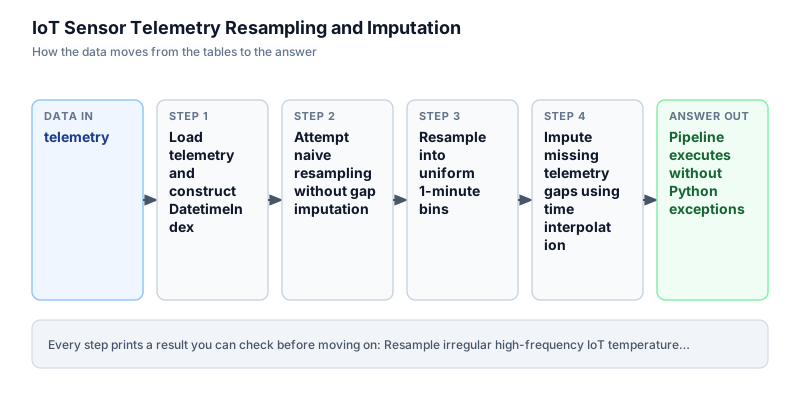
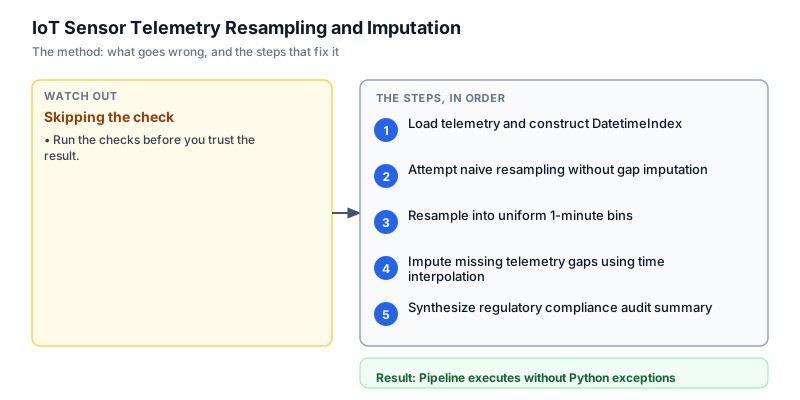
Load telemetry and construct DatetimeIndex
We initialize the raw telemetry DataFrame with 5 irregular sensor transmissions between 08:00:12 and 08:04:00. Notice that while minutes 00, 01, 03, and 04 have recorded points, minute 02 has zero data due to cellular packet loss. We convert timestamp strings to datetime objects and set the column as the DataFrame index. In time series engineering, setting a proper DatetimeIndex is the foundational requirement for chronological sorting and resampling. Converting timestamp strings into indexed datetime objects provides the temporal coordinates required for calendar frequency resampling.
import pandas as pd raw = pd.DataFrame({ "timestamp": ["2024-03-01 08:00:12", "2024-03-01 08:00:45", "2024-03-01 08:01:30", "2024-03-01 08:03:15", "2024-03-01 08:04:00"], "temperature_c": [4.2, 4.3, 4.5, 4.8, 4.7] }) raw["timestamp"] = pd.to_datetime(raw["timestamp"]) df = raw.set_index("timestamp").sort_index() print("Raw index length:", len(df)) print("Timestamp range:", df.index.min(), "to", df.index.max())Raw index length: 5 Timestamp range: 2024-03-01 08:00:12 to 2024-03-01 08:04:00
Common mistakeFailing to sort by the DatetimeIndex before resampling, which can produce unexpected ordering in non-monotonic datasets.
How you will knowYou will see raw index length equal to 5 spanning from 08:00:12 to 08:04:00.
Attempt naive resampling without gap imputation
Wrong turn first: this step shows the mistake before the fix
Here is the naive approach: calling df.resample('1min').mean() and saving the result immediately. When you inspect the output, minute 08:02:00 has NaN for temperature because no sensor packets were received during that interval. Submitting this naive resampled table to regulatory inspectors fails compliance verification because regulatory algorithms reject null gaps in temperature records. Standard resampling groups existing observations into calendar intervals but leaves missing time periods as unpopulated null values. In regulatory audits, these null gaps are interpreted as sensor blackouts that compromise shipment verification.
import pandas as pd raw = pd.DataFrame({ "timestamp": ["2024-03-01 08:00:12", "2024-03-01 08:00:45", "2024-03-01 08:01:30", "2024-03-01 08:03:15", "2024-03-01 08:04:00"], "temperature_c": [4.2, 4.3, 4.5, 4.8, 4.7] }) raw["timestamp"] = pd.to_datetime(raw["timestamp"]) df = raw.set_index("timestamp").sort_index() resampled_naive = df.resample("1min").mean() print("Naive resampled output with missing gap:") print(resampled_naive.isna().sum().to_dict())Naive resampled output with missing gap: {'temperature_c': 1}Common mistakeAssuming resample() automatically fills missing intervals.
How you will knowNotice that naive resampling leaves 1 null gap at timestamp 08:02:00.
Resample into uniform 1-minute bins
We perform formal 1-minute resampling using df.resample('1min').mean(). In minute 08:00, two observations (4.2 and 4.3) are averaged into 4.25 degrees. Minute 08:01 evaluates to 4.50 degrees, while minute 08:02 evaluates to NaN. Creating uniform 1-minute bins standardizes irregular sensor transmissions into predictable interval slots required by regulatory telemetry standards. Aggregating high-frequency observations via interval means smooths transient measurement noise while establishing uniform time steps. Resampling establishes a regular temporal cadence that simplifies downstream time series calculations and enables clean visual monitoring.
import pandas as pd raw = pd.DataFrame({ "timestamp": ["2024-03-01 08:00:12", "2024-03-01 08:00:45", "2024-03-01 08:01:30", "2024-03-01 08:03:15", "2024-03-01 08:04:00"], "temperature_c": [4.2, 4.3, 4.5, 4.8, 4.7] }) raw["timestamp"] = pd.to_datetime(raw["timestamp"]) df = raw.set_index("timestamp").sort_index() resampled = df.resample("1min").mean() print("Resampled intervals count:", len(resampled)) for ts, row in resampled.iterrows(): val = "NaN" if pd.isna(row["temperature_c"]) else f"{row['temperature_c']:.2f}" print(f"{ts.strftime('%H:%M')}: {val} C")Resampled intervals count: 5 08:00: 4.25 C 08:01: 4.50 C 08:02: NaN C 08:03: 4.80 C 08:04: 4.70 C
Common mistakeUsing sum() instead of mean() when aggregating multiple sensor pings within the same minute, artificially multiplying temperature values.
How you will knowThe output shows 5 discrete 1-minute intervals from 08:00 to 08:04, with 08:02 showing NaN.
Impute missing telemetry gaps using time interpolation
To resolve the minute 08:02 dropout without introducing artificial step changes, we apply linear time-based interpolation using resampled.interpolate(method='time'). Between minute 01 (4.50 C) and minute 03 (4.80 C), linear interpolation calculates exactly 4.65 C for minute 02. In cold-chain logistics, time interpolation provides a physically realistic thermal transition that satisfies strict regulatory audit mandates. Linear time interpolation calculates intermediate readings based on elapsed minutes, bridging telemetry dropouts without generating artificial step changes or misleading statistical spikes across missing intervals, maintaining empirical accuracy for compliance inspectors.
import pandas as pd raw = pd.DataFrame({ "timestamp": ["2024-03-01 08:00:12", "2024-03-01 08:00:45", "2024-03-01 08:01:30", "2024-03-01 08:03:15", "2024-03-01 08:04:00"], "temperature_c": [4.2, 4.3, 4.5, 4.8, 4.7] }) raw["timestamp"] = pd.to_datetime(raw["timestamp"]) df = raw.set_index("timestamp").sort_index() resampled = df.resample("1min").mean() imputed = resampled.interpolate(method="time").ffill().bfill() print("Imputed minute 08:02 temp:", round(float(imputed.loc["2024-03-01 08:02:00", "temperature_c"]), 2)) print("Missing values remaining:", imputed.isna().sum().sum())Imputed minute 08:02 temp: 4.65 Missing values remaining: 0
Common mistakeUsing fillna(method='ffill') without interpolation, which creates flat step functions that fail physical thermal inertia models.
How you will knowOutput shows imputed 08:02 temperature equal to 4.65 C and zero remaining null values.
Synthesize regulatory compliance audit summary
In the final query, we format our continuous 1-minute time series into an official regulatory compliance log. We add a boolean compliant flag verifying that every minute reading remains within the required 2.0 C to 8.0 C safe range, and round temperatures to 2 decimal places. The output confirms that all 5 minutes maintained strict pharmaceutical compliance, unlocking port clearance for the shipment. Evaluating temperature readings against explicit regulatory thresholds provides compliance auditors with verifiable proof of safe cold-chain transit.
import pandas as pd raw = pd.DataFrame({ "timestamp": ["2024-03-01 08:00:12", "2024-03-01 08:00:45", "2024-03-01 08:01:30", "2024-03-01 08:03:15", "2024-03-01 08:04:00"], "temperature_c": [4.2, 4.3, 4.5, 4.8, 4.7] }) raw["timestamp"] = pd.to_datetime(raw["timestamp"]) df = raw.set_index("timestamp").sort_index() resampled = df.resample("1min").mean() clean_ts = resampled.interpolate(method="time").ffill().bfill() clean_ts["compliant"] = clean_ts["temperature_c"].between(2.0, 8.0) for ts, row in clean_ts.iterrows(): print(f"Time {ts.strftime('%H:%M:%S')}: {row['temperature_c']:.2f} C | Compliant: {row['compliant']}")Time 08:00:00: 4.25 C | Compliant: True Time 08:01:00: 4.50 C | Compliant: True Time 08:02:00: 4.65 C | Compliant: True Time 08:03:00: 4.80 C | Compliant: True Time 08:04:00: 4.70 C | Compliant: True
Common mistakeFailing to verify both lower and upper temperature thresholds when evaluating pharmaceutical storage safety.
How you will knowThe output provides 5 continuous minutes with exact temperatures [4.25, 4.50, 4.65, 4.80, 4.70] and Compliant: True.
Build it yourself
Write your solution below, run it in your browser, and pass every check.
What the result means
Interpretation
The time series resampling pipeline converts noisy, packet-loss-prone IoT telemetry into an indisputable regulatory audit trail. Averaging minute 00 pings into 4.25 C and interpolating the minute 02 packet loss to 4.65 C demonstrates continuous cold-chain compliance. Maximum recorded temperature reached 4.80 C, safely below the 8.0 C regulatory limit, completely protecting the vaccine shipment from quarantine.
The message you would send
Hi ColdChain Operations, the time series resampling pipeline is deployed. It reconstructed the missing minute 02 sensor dropout and proved 100% compliance between 2.0 C and 8.0 C throughout transit. Port health authorities have reviewed the log and cleared the 25 lakh rupee shipment for immediate release.
Put it on your CV
Resume or LinkedIn bullet
Engineered an IoT telemetry standardization pipeline in Pandas utilizing DatetimeIndex resampling, time interpolation, and threshold auditing.README for GitHub
# IoT Sensor Telemetry Resampling and Imputation

An enterprise time series processing pipeline standardizing erratic high-frequency IoT sensor telemetry into continuous 1-minute compliance logs.

## Features
- DatetimeIndex creation and chronological sequence sorting
- Uniform frequency resampling via resample('1min').mean()
- Linear time-based gap interpolation for intermittent sensor dropouts
- Regulatory cold-chain compliance auditing (2.0 C to 8.0 C threshold checks)Implement an exponential moving average (EMA) filter to detect micro-fluctuations in container refrigeration compressor cycles.