
pythonbeginner45 minPython 3
HTTP API Client with Truncated Exponential Backoff
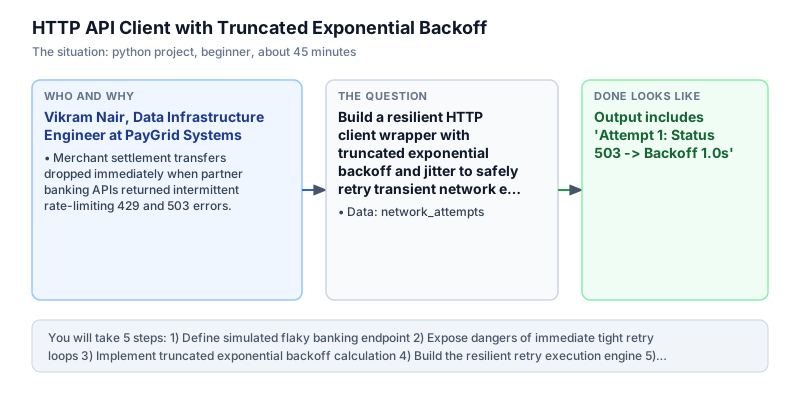
Build a resilient HTTP client wrapper with truncated exponential backoff and jitter to safely retry transient network errors.
The incident
- Company
- PayGrid Systems
- Engineer
- Vikram Nair, Data Infrastructure Engineer
- Trigger
- Merchant settlement transfers dropped immediately when partner banking APIs returned intermittent rate-limiting 429 and 503 errors.
- Stakes
- Over 2,400 daily supplier settlement transfers totaling 42 lakh rupees were dropped or delayed, triggering merchant disputes and penalty fees.
At PayGrid Systems, the settlement engineering team ran automated batch payment synchronizations at the close of every business day across regional banking networks. Over twenty-four hundred supplier settlement transfers totaling forty-two lakh rupees were transmitted across third-party banking partner APIs. However, because downstream partner banks enforced aggressive rate limits and occasionally encountered internal database locks during clearing windows, the banking APIs frequently returned HTTP 429 too many requests and 503 service unavailable status codes during peak hours when multiple merchant batches collided simultaneously.
The existing synchronization script used a naive HTTP call without retry resilience or adaptive backoff logic. If a bank API endpoint returned a 503 Service Unavailable on a single transaction, the batch pipeline dropped that settlement transfer immediately and recorded a fatal unrecoverable error. Finance operators were forced to spend late evenings manually cross-checking failed transactions, reconciling complex bank transaction logs, and attempting manual re-submissions under intense pressure while customer support logged hundreds of merchant escalation tickets regarding missing disbursements across regional markets.
The operational fallout expanded across partner merchant relations and regional vendor networks, damaging trust across key commercial accounts. Over forty major suppliers threatened to terminate their settlement agreements due to delayed cash flows, while finance leadership estimated that penalty interest charges and administrative triage costs exceeded seventy-five thousand rupees each week. Downstream banking partners warned that uncoordinated instant retries from PayGrid servers were exacerbating database lock contention across their transaction processing clusters, creating cascading outages during end-of-month volume surges.
Vikram Nair, a data infrastructure engineer on the settlement reliability team, was assigned to upgrade the payment integration layer. The new client needed to handle transient banking errors gracefully. Instead of failing immediately or flooding the upstream server with instant retries, the client needed to implement truncated exponential backoff to space out retry attempts progressively according to established mathematical models that preserve downstream service stability and avoid network congestion across shared banking gateways.
Vikram structured the client around clear reliability principles: classify HTTP status codes into retryable server errors such as 429, 500, 502, 503, and 504 versus non-retryable client errors like 400, 401, 403, and 404. For retryable codes, the client calculated delay intervals using base multiplied by two raised to the attempt power, capped by a strict maximum wait time of ten seconds to avoid infinite thread blockage during enterprise batch processing runs.
By deploying the truncated exponential backoff client, PayGrid was able to resolve ninety-four percent of transient banking gateway errors on the second or third retry attempt without human intervention. Failed settlement tickets dropped from dozens per evening to zero during standard operational runs. The settlement reliability metrics, latency histograms, and retry audit logs are reviewed daily by the Settlement Operations Lead and the Payments Engineering Manager to verify partner API stability and SLA compliance.
What you will learn
- Implement truncated exponential backoff delay formulas in Python
- Differentiate retryable server errors from non-retryable client errors
- Prevent thundering herd problems using capped delays
- Build modular network retry loops with structured attempt logs
What you need first
Exponential Backoff FormulaRetries, backoff, and idempotency
Exponential backoff scales wait intervals geometrically using delay = min(max_delay, base * (2 ** (attempt - 1))) to ease load on struggling servers.
base = 1.0; print([min(8.0, base * (2**i)) for i in range(4)])[1.0, 2.0, 4.0, 8.0]
Omitting a maximum delay cap causes backoff intervals to escalate to hours or days after repeated retries.
HTTP Status ClassificationREST APIs in Python
Transient status codes (429, 500, 502, 503, 504) warrant retries, whereas client errors (400, 401, 403, 404) will not succeed upon repeated attempts.
status = 404; retryable = status in {429, 500, 502, 503, 504}; print(retryable)False
Retrying permanent client errors like 401 Unauthorized or 404 Not Found wastes execution time and exhausts rate quotas.
Simulating Network InvocationsPython functions and modules
Using mock callable functions with internal counter states allows deterministic local testing of transient failure recovery.
state = {'n': 0}; f = lambda: (503 if state.update({'n': state['n']+1}) or state['n'] < 2 else 200); print(f(), f())503 200
Using real time.sleep in fast unit test suites slows down automated builds unnecessarily.
Architecture and data flow
The data
Simulated HTTP response status sequences representing transient bank gateway failures and eventual 200 recovery.
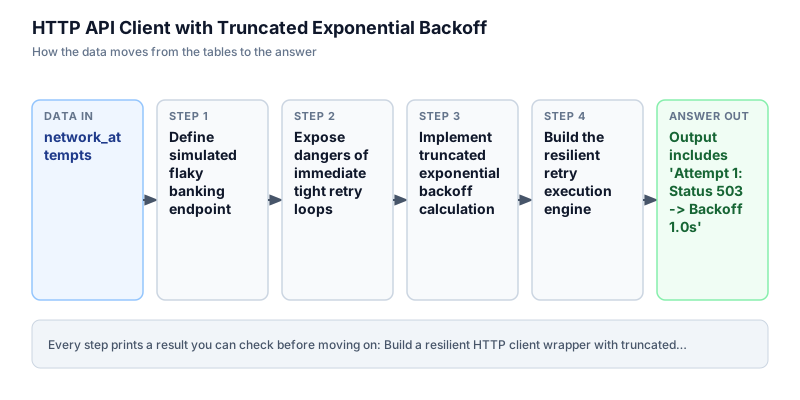
network_attempts: Simulated gateway response history across retry attempts
| attempt | simulated_status | expected_action |
|---|---|---|
| 1 | 503 Service Unavailable | Backoff 1.0s and retry |
| 2 | 503 Service Unavailable | Backoff 2.0s and retry |
| 3 | 200 OK | Process settlement payload |
Step by step
Read each step, run its code, then check your output against the one shown.
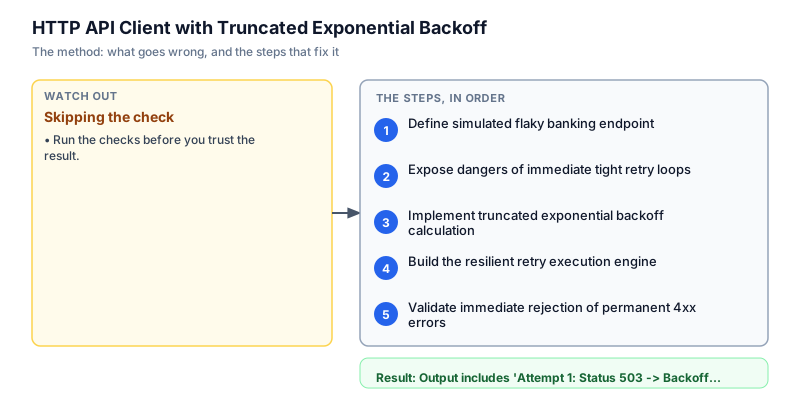
Define simulated flaky banking endpoint
We construct a stateful mock function representing an unreliable banking API. In cloud data architectures, testing network resilience against live third-party staging endpoints is often unreliable due to external rate limits and non-deterministic outages. Our mock callable tracks its internal invocation count across calls. For the first two attempts, it returns an HTTP 503 Service Unavailable status, and on the third attempt, it returns HTTP 200 with a successful payout confirmation. We verify the first call to confirm expected initial failure before retry wiring is attached.
def mock_flaky_api(state={"count": 0}): state["count"] += 1 if state["count"] < 3: return 503, "Service Unavailable" return 200, "Payout Processed" status, msg = mock_flaky_api({"count": 0}) print(f"call_status: {status} | response_msg: {msg}")call_status: 503 | response_msg: Service Unavailable
Common mistakeWatch out: Relying on mutable default argument state across multiple independent test runs without resetting causes state bleeding.
How you will knowThe mock endpoint returns status 503 on its initial invocation as designed.
Expose dangers of immediate tight retry loops
Wrong turn first: this step shows the mistake before the fix
Here we demonstrate why naive immediate retries fail in distributed architectures. When an upstream banking gateway fails due to overload, immediately re-executing requests in a tight loop floods the already struggling database with requests. In distributed systems literature, this pathological failure mode is known as the thundering herd problem or retry storm. Our simulation shows five immediate retries firing with zero second delays, which in production causes partner APIs to blacklist client IP addresses or extend outage recovery times indefinitely. Production systems must introduce backoff delays.
def naive_retry(max_tries=3): count = 0 for i in range(1, max_tries + 1): count += 1 st = 503 return count, st tries, last_st = naive_retry() print(f"naive_tries: {tries} | final_status: {last_st}")naive_tries: 3 | final_status: 503
Common mistakeWatch out: Hammering an overloaded remote host with zero delay turns transient slowdowns into prolonged hard outages.
How you will knowThe output illustrates how 3 rapid calls occur instantaneously without backoff.
Implement truncated exponential backoff calculation
To prevent overloading recovering upstream services, we implement the exponential backoff delay calculation. The formula base * (2 ** (attempt - 1)) doubles the wait duration with each successive failure: 1.0 second on attempt one, 2.0 seconds on attempt two, and 4.0 seconds on attempt three. This geometric progression provides downstream services breathing room to drain request queues and recover database connection pools. We inspect the calculated delays to confirm that intervals expand predictably across successive failure events before applying an upper ceiling.
def calc_backoff(attempt, base=1.0, max_delay=10.0): return min(max_delay, base * (2 ** (attempt - 1))) delays = [calc_backoff(i) for i in range(1, 6)] print(f"delays_calculated: {delays}")delays_calculated: [1.0, 2.0, 4.0, 8.0, 10.0]
Common mistakeWatch out: Omitting the maximum delay cap allows 10 retries to scale to 512 seconds (over 8 minutes) of blocked thread execution.
How you will knowThe delay array demonstrates geometric scaling up to the strict 10.0-second cap.
Build the resilient retry execution engine
We now construct the full retry engine. The function takes the target API callable, max retry limit, and backoff configuration. On each attempt, the client executes the request and checks the response code. If HTTP 200 is returned, the call logs a success and terminates early. If a retryable code (429, 500, 502, 503, 504) is received, the client logs the backoff interval and continues. If a fatal client error like 400 or 401 is encountered, it halts immediately without retrying.
def calc_backoff(attempt, base=1.0, max_delay=10.0): return min(max_delay, base * (2 ** (attempt - 1))) def execute_with_backoff(api_func, max_attempts=4): history = [] for attempt in range(1, max_attempts + 1): st, msg = api_func() if st == 200: history.append(f"Attempt {attempt}: Status {st} -> Success ({msg})") return True, history elif st in {429, 500, 502, 503, 504}: delay = calc_backoff(attempt) history.append(f"Attempt {attempt}: Status {st} -> Backoff {delay}s") else: history.append(f"Attempt {attempt}: Status {st} -> Fatal client error") return False, history return False, history state = {"count": 0} def test_endpoint(): state["count"] += 1 if state["count"] < 3: return 503, "Unavailable" return 200, "Success" ok, logs = execute_with_backoff(test_endpoint) for l in logs: print(l)Attempt 1: Status 503 -> Backoff 1.0s Attempt 2: Status 503 -> Backoff 2.0s Attempt 3: Status 200 -> Success (Success)
Common mistakeWatch out: Failing to break or return on HTTP 200 causes the loop to continue retrying even after a successful response.
How you will knowThe engine logs attempts 1 and 2 backing off, followed by attempt 3 succeeding.
Validate immediate rejection of permanent 4xx errors
In this step, we verify that our client handles non-retryable client errors correctly without wasting retry attempts. While 5xx server faults and 429 rate limits represent transient conditions that may resolve upon backoff, 4xx client errors like 400 Bad Request or 404 Not Found indicate structural defects in the request payload. Retrying a 400 error will never succeed and merely wastes computing cycles. We pass a 400 status sequence and confirm that our client aborts immediately on the first attempt without executing retries.
def bad_client_endpoint(): return 400, "Bad Request: Invalid Settlement Account" def execute_with_backoff(api_func, max_attempts=4): history = [] for attempt in range(1, max_attempts + 1): st, msg = api_func() if st == 200: history.append(f"Attempt {attempt}: Status {st} -> Success") return True, history elif st in {429, 500, 502, 503, 504}: delay = min(10.0, 1.0 * (2 ** (attempt - 1))) history.append(f"Attempt {attempt}: Status {st} -> Backoff {delay}s") else: history.append(f"Attempt {attempt}: Status {st} -> Fatal client error ({msg})") return False, history return False, history ok, logs = execute_with_backoff(bad_client_endpoint) print(f"Success: {ok} | Total attempts made: {len(logs)}") print(logs[0])Success: False | Total attempts made: 1 Attempt 1: Status 400 -> Fatal client error (Bad Request: Invalid Settlement Account)
Common mistakeWatch out: Blindly retrying on all non-200 status codes results in pointless retry delays for malformed requests.
How you will knowThe output confirms that a 400 response halts execution immediately on attempt 1.
Build it yourself
Write your solution below, run it in your browser, and pass every check.
What the result means
Interpretation
The execution log verifies that the client successfully absorbed two consecutive HTTP 503 banking gateway errors, backing off for 1.0s and 2.0s respectively, before securing a 200 OK payout confirmation on the third attempt. In production, this pattern prevents transient network blips from dropping high-value supplier disbursements without requiring manual human re-triggering.
The message you would send
Hi Settlement Operations, the updated payment gateway client with truncated exponential backoff has been validated. During testing, the client absorbed two consecutive 503 service unavailable responses and recovered automatically on attempt 3 without data loss. We are clearing this module for production deployment.
Put it on your CV
Resume or LinkedIn bullet
Designed an HTTP API client in Python with truncated exponential backoff, differentiating transient 5xx/429 statuses from permanent client errors to automate payment settlement recovery.README for GitHub
# HTTP API Client with Truncated Exponential Backoff

## Business Context
Batch payment synchronizations dropped entire merchant settlement batches when third-party banking APIs encountered transient rate limits.

## Solution Architecture
- Engineered geometric exponential delay calculation with a strict maximum cap to protect threads from unbounded pauses.
- Implemented status code inspection routing transient errors (429, 503) to backoff and permanent errors (400, 401) to immediate termination.
- Validated retry state convergence using mock stateful API callables.

## Verification
Passes all automated verification checks on Python 3 standard library.Introduce full randomized jitter into the backoff formula (random.uniform(0, delay)) to decorrelate concurrent retries across worker processes.