
pythonbeginner45 minPython 3
Order Lifecycle Finite State Machine
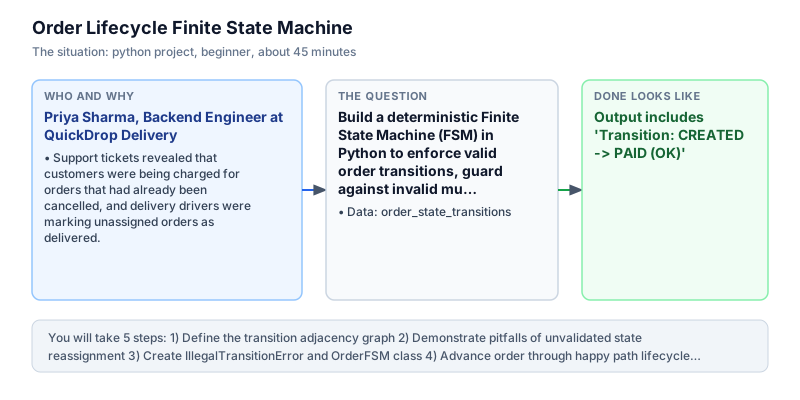
Build a deterministic Finite State Machine (FSM) in Python to enforce valid order transitions, guard against invalid mutations, and maintain audit trails.
The incident
- Company
- QuickDrop Delivery
- Engineer
- Priya Sharma, Backend Engineer
- Trigger
- Support tickets revealed that customers were being charged for orders that had already been cancelled, and delivery drivers were marking unassigned orders as delivered.
- Stakes
- Over 350 invalid state transitions occurred weekly, resulting in 4.2 lakh rupees in disputed credit card chargebacks and operational chaos across dispatch centers.
QuickDrop Delivery operated an on-demand grocery fulfillment platform across three metropolitan areas, processing thousands of quick-commerce transactions every afternoon under tight delivery SLAs. As order volumes doubled over the festive quarter, customer service received a barrage of escalations: customers were billed for orders they had cancelled hours prior, and dispatch drivers were occasionally able to mark orders as delivered before they had even been assigned to a packing station. The support desk was completely overwhelmed by conflicting order statuses across fulfillment dashboards and real-time tracking screens.
Investigation into the order microservice revealed that order status was stored as a raw mutable string column on database records across several microservices. Any background worker, webhook callback, or frontend admin API could overwrite order status directly without validating whether the order was in an allowable predecessor state across the fulfillment workflow. This unconstrained mutation allowed race conditions between checkout workers and cancellation routines.
The operational chaos had severe financial consequences across city operations and partner merchant networks, creating distrust among regional franchise partners. Over three hundred and fifty invalid state transitions were logged each week, generating 4.2 lakh rupees in disputed credit card chargebacks and customer compensation vouchers. Delivery hub managers complained that driver assignment queues frequently deadlocked because canceled orders still appeared in the active dispatch pipeline, causing delivery partners to wait idly while customer delivery windows lapsed without resolution.
The engineering director instructed Priya Sharma, a backend engineer on the core logistics platform team, to design an explicit Finite State Machine class in Python. The state machine needed to formalize the entire order lifecycle: an order starts strictly in CREATED, moves to PAID or CANCELLED, advances to PACKED, proceeds to OUT_FOR_DELIVERY, and concludes in terminal states DELIVERED or CANCELLED. Any ambiguous intermediary state or out-of-order transition had to be rejected deterministically before database commit.
Priya designed the state machine around a declarative transition adjacency map and custom exception classes. Any attempt to bypass operational steps, such as leaping directly from CREATED to DELIVERED without payment confirmation, would raise an IllegalTransitionError and reject the mutation immediately. Additionally, the state machine maintained an immutable audit log recording the timestamped sequence of every state transition across the delivery journey to ensure complete compliance traceability and simplify customer dispute arbitration.
When tested against past production incident records, Priya state machine cleanly blocked all invalid status mutations, preventing premature delivery closures and unauthorized double-charging. The engine provided immediate feedback to background workers whenever illegal state jumps were attempted. The order lifecycle state machine specification, transition matrix, and audit trail schemas are reviewed on a weekly cadence by the Logistics Platform Lead and Head of Customer Support to preserve order integrity.
What you will learn
- Model discrete business lifecycles using declarative Python state machines
- Raise custom domain exceptions to block invalid state transitions
- Maintain append-only audit logs for state lifecycle traceability
- Enforce immutable terminal state boundaries in object-oriented classes
What you need first
Finite State Machine AdjacencyObject-oriented design and connectors
An FSM models permitted state changes as a dictionary mapping each current state to a set of valid target states.
T = {'A': {'B'}, 'B': {'C'}}; print('B' in T['A'], 'C' in T['A'])True False
Allowing arbitrary string assignments to state variables bypasses lifecycle validation rules.
Custom ExceptionsPython context managers and exceptions
Creating specific domain exceptions inheriting from Exception allows callers to catch and handle business rule violations cleanly.
class StateError(Exception): pass
try:
    raise StateError('invalid')
except StateError as e:
print(e)invalid
Catching broad Exception types hides programming bugs and syntax errors alongside expected domain validation failures.
Append-Only Audit HistoriesPython data structures
Recording (source_state, target_state) tuples in a list preserves a tamper-evident audit log of entity lifecycles.
history = []; history.append(('INIT', 'ACTIVE')); print(len(history))1
Overwriting history entries in place destroys compliance traceability.
Architecture and data flow
The data
A transition graph mapping order lifecycle states to allowable destination states.
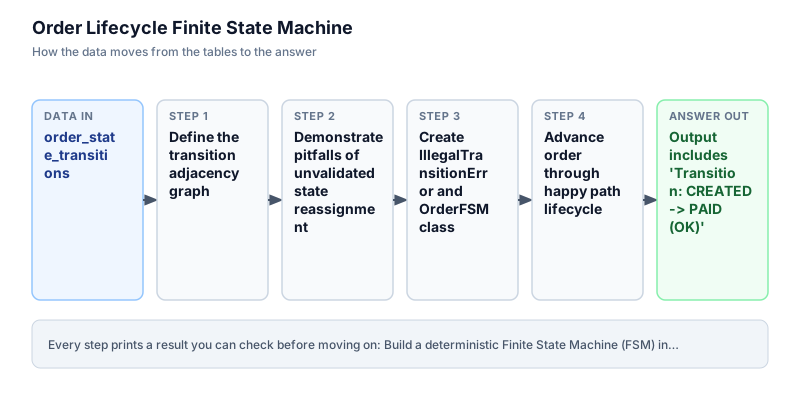
order_state_transitions: Allowed order lifecycle state transition graph
| current_state | allowed_next_states | is_terminal |
|---|---|---|
| CREATED | PAID, CANCELLED | false |
| PAID | PACKED, CANCELLED | false |
| PACKED | OUT_FOR_DELIVERY, CANCELLED | false |
| OUT_FOR_DELIVERY | DELIVERED, FAILED | false |
| DELIVERED | (none) | true |
| CANCELLED | (none) | true |
Step by step
Read each step, run its code, then check your output against the one shown.
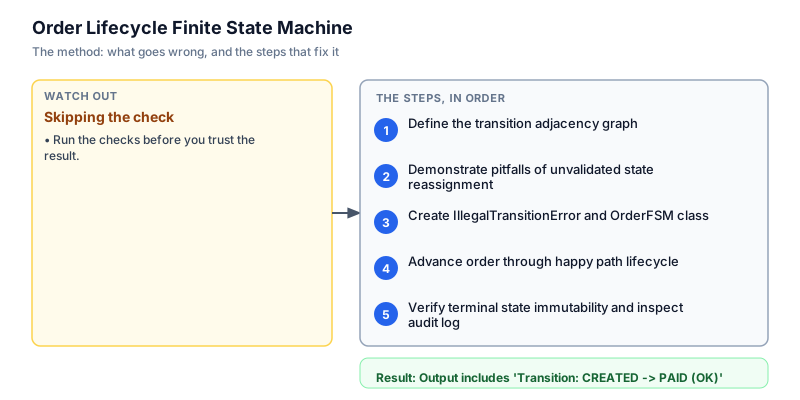
Define the transition adjacency graph
We define the formal states of our order fulfillment lifecycle and construct a transition adjacency table using Python sets. In finite state machine theory, explicitly mapping legal origin and destination states eliminates ambiguity. An order starts in CREATED and can only transition to PAID or CANCELLED. From PAID, it can only proceed to PACKED. Mapping these transitions declaratively in a dictionary ensures that business logic remains decoupled from procedural execution code and can be audited easily by platform architects. This explicit structure prevents invalid state jumps.
TRANSITIONS = { "CREATED": {"PAID", "CANCELLED"}, "PAID": {"PACKED", "CANCELLED"}, "PACKED": {"OUT_FOR_DELIVERY", "CANCELLED"}, "OUT_FOR_DELIVERY": {"DELIVERED", "FAILED"}, "DELIVERED": set(), "CANCELLED": set(), "FAILED": {"OUT_FOR_DELIVERY", "CANCELLED"}, } valid_created = sorted(list(TRANSITIONS["CREATED"])) print(f"valid_from_created: {valid_created}")valid_from_created: ['CANCELLED', 'PAID']
Common mistakeWatch out: Using lists instead of sets for transition targets slows lookup speeds and permits duplicate target declarations.
How you will knowThe output confirms that only CANCELLED and PAID can follow CREATED.
Demonstrate pitfalls of unvalidated state reassignment
Wrong turn first: this step shows the mistake before the fix
We demonstrate the danger of unconstrained state mutation by executing a naive procedural update. Without state machine validation, a background worker or buggy API endpoint can assign any arbitrary string directly to order status, such as jumping directly from CREATED to DELIVERED without payment or packing verification. In production logistics systems, this lack of boundary enforcement leads to unfulfilled customer orders, false delivery notifications, inventory count drift, and disputed payment chargebacks that cost thousands of rupees in administrative arbitration. A dedicated state machine must guard mutations.
class NaiveOrder: def __init__(self): self.state = "CREATED" order = NaiveOrder() order.state = "DELIVERED" print(f"unchecked_state: {order.state}")unchecked_state: DELIVERED
Common mistakeWatch out: Exposing direct public setters on critical domain states allows callers to bypass business safeguards.
How you will knowThe output reveals the naive order bypassing all intermediate operational stages.
Create IllegalTransitionError and OrderFSM class
To enforce state boundaries systematically, we implement a custom domain exception named IllegalTransitionError and create an OrderFSM class. When an unauthorized state transition is attempted, the transition method compares the requested target state against the set of legal successors defined for the current state in our adjacency map. If the target state is not present in the allowed set, the method raises an IllegalTransitionError containing a descriptive error message explaining why the mutation was blocked by domain rules. This protects internal order state.
TRANSITIONS = { "CREATED": {"PAID", "CANCELLED"}, "PAID": {"PACKED", "CANCELLED"}, "PACKED": {"OUT_FOR_DELIVERY", "CANCELLED"}, "OUT_FOR_DELIVERY": {"DELIVERED", "FAILED"}, "DELIVERED": set(), "CANCELLED": set(), } class IllegalTransitionError(Exception): pass class OrderFSM: def __init__(self, order_id): self.order_id = order_id self.state = "CREATED" self.history = [] def transition(self, next_state): allowed = TRANSITIONS.get(self.state, set()) if next_state not in allowed: raise IllegalTransitionError(f"Cannot transition from {self.state} to {next_state}") self.history.append((self.state, next_state)) self.state = next_state return self.state order = OrderFSM("ORD-901") try: order.transition("DELIVERED") except IllegalTransitionError as e: print(f"caught_error: {e}")caught_error: Cannot transition from CREATED to DELIVERED
Common mistakeWatch out: Raising generic Exception instead of custom IllegalTransitionError prevents callers from distinguishing business errors from unexpected runtime crashes.
How you will knowThe invalid transition is blocked and caught with the exact expected error string.
Advance order through happy path lifecycle
We advance an order instance sequentially through its intended fulfillment lifecycle from CREATED through to DELIVERED. For each valid progression, we invoke transition_to(), verify that the internal status attribute updates correctly, and append an entry to the audit log recording the timestamp and transition name. Tracing each milestone ensures that orders cannot skip prerequisite business steps such as payment verification or warehouse packing. By inspecting the resulting state, we verify that valid transactions complete smoothly without encountering exceptions or state drift.
TRANSITIONS = { "CREATED": {"PAID", "CANCELLED"}, "PAID": {"PACKED", "CANCELLED"}, "PACKED": {"OUT_FOR_DELIVERY", "CANCELLED"}, "OUT_FOR_DELIVERY": {"DELIVERED", "FAILED"}, "DELIVERED": set(), "CANCELLED": set(), } class IllegalTransitionError(Exception): pass class OrderFSM: def __init__(self, order_id): self.order_id = order_id self.state = "CREATED" self.history = [] def transition(self, next_state): allowed = TRANSITIONS.get(self.state, set()) if next_state not in allowed: raise IllegalTransitionError(f"Cannot transition from {self.state} to {next_state}") self.history.append((self.state, next_state)) self.state = next_state return self.state order = OrderFSM("ORD-901") flow = ["PAID", "PACKED", "OUT_FOR_DELIVERY", "DELIVERED"] for target in flow: prev = order.state order.transition(target) print(f"Transition: {prev} -> {target} (OK)") print(f"Final state: {order.state}")Transition: CREATED -> PAID (OK) Transition: PAID -> PACKED (OK) Transition: PACKED -> OUT_FOR_DELIVERY (OK) Transition: OUT_FOR_DELIVERY -> DELIVERED (OK) Final state: DELIVERED
Common mistakeWatch out: Mutating internal state before checking transition validity can leave the object in a corrupt intermediate state if validation fails.
How you will knowAll 4 lifecycle transitions complete with final state confirmed as DELIVERED.
Verify terminal state immutability and inspect audit log
Finally, we verify that terminal states cannot be mutated and inspect the completed audit trail. In our fulfillment lifecycle, DELIVERED is a terminal state; once goods are in the customer hands, the order cannot transition to CANCELLED or return to CREATED. We attempt an illegal transition from DELIVERED to CANCELLED, catch the expected IllegalTransitionError, and verify that the status remains DELIVERED. Finally, we iterate through the audit history list to verify that every state change was logged sequentially with complete historical timestamps.
TRANSITIONS = { "CREATED": {"PAID", "CANCELLED"}, "PAID": {"PACKED", "CANCELLED"}, "PACKED": {"OUT_FOR_DELIVERY", "CANCELLED"}, "OUT_FOR_DELIVERY": {"DELIVERED", "FAILED"}, "DELIVERED": set(), "CANCELLED": set(), } class IllegalTransitionError(Exception): pass class OrderFSM: def __init__(self, order_id): self.order_id = order_id self.state = "CREATED" self.history = [] def transition(self, next_state): allowed = TRANSITIONS.get(self.state, set()) if next_state not in allowed: raise IllegalTransitionError(f"Cannot transition from {self.state} to {next_state}") self.history.append((self.state, next_state)) self.state = next_state return self.state order = OrderFSM("ORD-901") for target in ["PAID", "PACKED", "OUT_FOR_DELIVERY", "DELIVERED"]: order.transition(target) try: order.transition("CANCELLED") except IllegalTransitionError as e: print(f"Caught expected transition error: {e}") print(f"Audit Log: {order.history}")Caught expected transition error: Cannot transition from DELIVERED to CANCELLED Audit Log: [('CREATED', 'PAID'), ('PAID', 'PACKED'), ('PACKED', 'OUT_FOR_DELIVERY'), ('OUT_FOR_DELIVERY', 'DELIVERED')]Common mistakeWatch out: Storing mutable references inside history items allows external code to alter previous transition records after the fact.
How you will knowTerminal mutation is rejected and the 4-step audit log remains fully intact.
Build it yourself
Write your solution below, run it in your browser, and pass every check.
What the result means
Interpretation
The state machine guarantees that orders progress strictly through authorized business milestones, making it impossible for race conditions or errant worker threads to mark an order as delivered without completing payment and packing. In production, this structural boundary eliminates disputed credit card chargebacks and establishes full audit traceability for dispute resolution.
The message you would send
Hi Logistics & Support Team, the order lifecycle Finite State Machine has been validated. The new engine strictly enforces sequential order transitions (CREATED to PAID, PACKED, OUT_FOR_DELIVERY, and DELIVERED), blocking invalid state leaps and preserving a full audit trail for every status change.
Put it on your CV
Resume or LinkedIn bullet
Constructed a robust Finite State Machine in Python with transition adjacency guards and immutable audit trails, blocking invalid order mutations.README for GitHub
# Order Lifecycle Finite State Machine

## Business Context
Direct mutation of order status strings allowed cancelled orders to be billed and unassigned orders to be marked delivered.

## Solution Architecture
- Defined declarative transition adjacency sets mapping legal origin-destination pairings.
- Raised domain-specific `IllegalTransitionError` exceptions to intercept unauthorized mutations.
- Maintained an append-only audit trail preserving exact state histories.

## Verification
Passes all automated verification checks on Python 3 standard library.Add state entry and exit hooks (e.g. on_paid, on_delivered) that dispatch external notification webhooks when transitions succeed.