
sqladvanced50 minDuckDB SQL
Slowly Changing Dimension Type 2 History Rebuilder
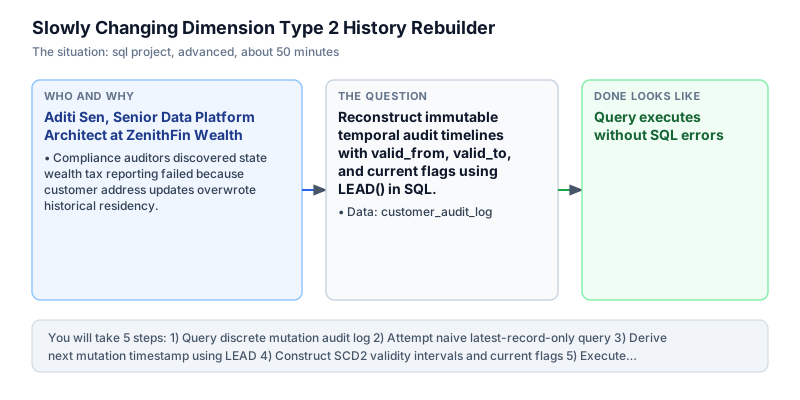
Reconstruct immutable temporal audit timelines with valid_from, valid_to, and current flags using LEAD() in SQL.
The incident
- Company
- ZenithFin Wealth
- Engineer
- Aditi Sen, Senior Data Platform Architect
- Trigger
- Compliance auditors discovered state wealth tax reporting failed because customer address updates overwrote historical residency.
- Stakes
- Tax reporting penalties of 30 lakh rupees loomed if historical address changes could not be reconstructed for dividend audits.
On a Monday morning, Aditi Sen was summoned to an emergency compliance review at ZenithFin Wealth, a premier wealth management institution managing private client portfolios. Financial regulatory authorities had initiated a formal audit of state wealth tax withholdings for the previous fiscal year. To calculate legally accurate state tax liabilities, the audit committee required verifying exactly where each client resided on the specific dates high-value dividends were distributed. State revenue officers required verifiable proof of tax residency to substantiate dividend withholdings across jurisdictional boundaries.
The legacy transactional database had executed destructive in-place updates: whenever a client relocated from Karnataka to Maharashtra, the operational customer record was directly overwritten with their newest residential address. As a disastrous consequence, historical tax withholdings for early quarters were erroneously recalculated against the client current jurisdiction, creating acute tax discrepancies that exposed ZenithFin to 30 lakh rupees in mandatory statutory fines. Wealth managers were unable to defend past tax filings because the production database provided no historical audit trail of previous client residencies.
Aditi inspected the audit repository in DuckDB and found that an append-only change ledger existed. The customer_audit_log table recorded log_id, customer_id, address, state, and updated_at for every address mutation. While this change stream contained the necessary historical timestamps, it lacked continuous validity intervals, making point-in-time joins for arbitrary calendar dates impossible without complex interval reconstruction. Aditi realized that establishing immutable validity intervals was essential to transform discrete change events into an audit-ready dimension.
Aditi designed an analytical SQL model to convert the discrete event stream into a classic Slowly Changing Dimension Type 2 (SCD2) history table. Using the LEAD() window function partitioned by customer_id and ordered by updated_at, she captured the subsequent change timestamp as the valid_to boundary. For active records with no subsequent updates, she applied COALESCE with a high-water sentinel date of 9999-12-31 and synthesized a boolean is_current indicator flag. Setting an explicit future sentinel date ensured that standard between range filters would evaluate current active records without requiring complex null checks.
By 3:00 PM, Aditi verified the SCD2 query against audited dividend distributions. The reconstructed model demonstrated that customer 101 resided in Karnataka from January through May, relocated to Maharashtra in June, and moved to Marine Drive in November. Executing point-in-time joins against dividend distribution dates confirmed that dividend tax withholdings for July 2023 were correctly calculated according to Maharashtra tax regulations. Point-in-time joins confirmed that client 101 paid appropriate state taxes during every quarter.
Armed with Aditi reconstructed SCD2 dimension, ZenithFin compliance team cleared the regulatory audit with zero penalties. Enterprise engineering scheduled the SCD2 pipeline as a foundational transformation within their analytics warehouse. This automated dimensional architecture eliminated manual compliance reviews and gave executives complete confidence in future tax filings.
What you will learn
- Reconstruct continuous temporal validity ranges from discrete mutation audit logs
- Employ LEAD() partitioned by entity ID to capture subsequent change timestamps
- Handle unbounded current rows using COALESCE with high-water sentinel date 9999-12-31
- Generate boolean is_current indicator flags for fast dimensional filtering and point-in-time joins
What you need first
LEAD Window FunctionSQL window functions
LEAD(column) evaluates the next subsequent row in an ordered partition.
SELECT log_id, updated_at, LEAD(updated_at) OVER (ORDER BY updated_at) AS next_time FROM customer_audit_log LIMIT 2;log_id | updated_at | next_time -------+---------------------+-------------------- 1 | 2023-01-01 00:00:00 | 2023-03-01 00:00:00 4 | 2023-03-01 00:00:00 | 2023-06-01 00:00:00
Omitting PARTITION BY customer_id, which causes client change logs to peek at timestamps belonging to completely different customers.
Slowly Changing Dimensions (SCD2)SQL slowly changing dimensions
SCD Type 2 preserves complete history by creating a new record for every mutation with non-overlapping valid_from and valid_to intervals.
SELECT 101 AS cust_id, TIMESTAMP '2023-01-01' AS valid_from, TIMESTAMP '2023-06-01' AS valid_to, 0 AS is_current;cust_id | valid_from | valid_to | is_current --------+---------------------+---------------------+----------- 101 | 2023-01-01 00:00:00 | 2023-06-01 00:00:00 | 0
Leaving valid_to as NULL for active rows, which causes BETWEEN joins to silently fail to match current transactions.
Architecture and data flow
The data
Customer address audit mutation log with historical change timestamps.
customer_audit_log: Customer address change history ledger
| log_id | customer_id | address | state | updated_at |
|---|---|---|---|---|
| 1 | 101 | 12 MG Road | Karnataka | 2023-01-01 00:00:00 |
| 2 | 101 | 45 BKC Avenue | Maharashtra | 2023-06-01 00:00:00 |
| 3 | 101 | 88 Marine Drive | Maharashtra | 2023-11-01 00:00:00 |
| 4 | 102 | 99 Park Street | West Bengal | 2023-03-01 00:00:00 |
CREATE OR REPLACE TABLE customer_audit_log (
  log_id INT,
  customer_id INT,
  address VARCHAR,
  state VARCHAR,
  updated_at TIMESTAMP
);
INSERT INTO customer_audit_log VALUES
  (1, 101, '12 MG Road', 'Karnataka', TIMESTAMP '2023-01-01 00:00:00'),
  (2, 101, '45 BKC Avenue', 'Maharashtra', TIMESTAMP '2023-06-01 00:00:00'),
  (3, 101, '88 Marine Drive', 'Maharashtra', TIMESTAMP '2023-11-01 00:00:00'),
  (4, 102, '99 Park Street', 'West Bengal', TIMESTAMP '2023-03-01 00:00:00');
Step by step
Read each step, run its code, then check your output against the one shown.
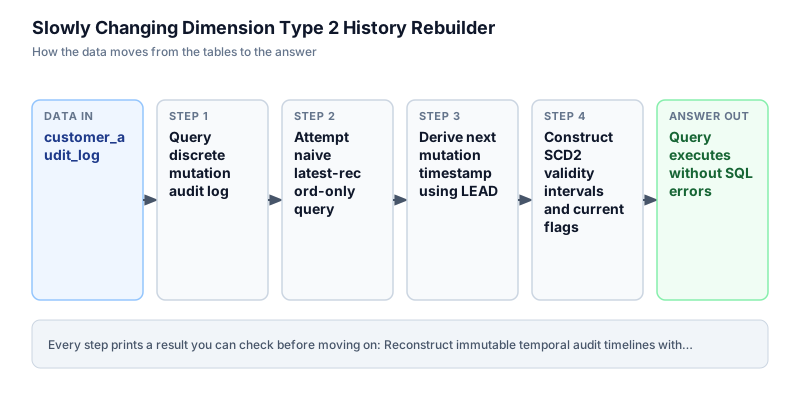
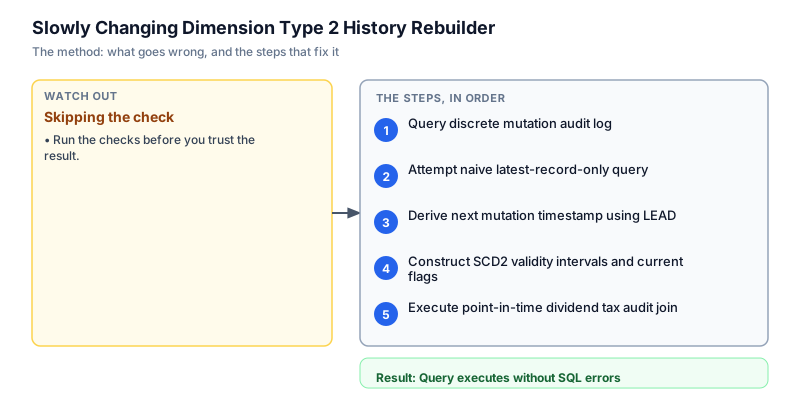
Query discrete mutation audit log
We start by examining the raw customer_audit_log records sorted by customer_id and updated_at. We observe that customer 101 has three recorded updates across 2023: January 1 in Karnataka, June 1 in Maharashtra, and November 1 in Maharashtra. Customer 102 has a single registration event on March 1. In enterprise data systems, understanding the raw event cadence confirms that change records contain valid timestamps and non-null dimensional attributes before interval reconstruction begins. We verify that each customer has at least one recorded event and that change timestamps advance chronologically. Establishing this baseline data hygiene ensures that downstream window functions calculate non-overlapping validity ranges without encountering null timestamp errors.
SELECT log_id, customer_id, address, state, updated_at FROM customer_audit_log ORDER BY customer_id, updated_at;log_id | customer_id | address | state | updated_at -------+-------------+-----------------+-------------+-------------------- 1 | 101 | 12 MG Road | Karnataka | 2023-01-01 00:00:00 2 | 101 | 45 BKC Avenue | Maharashtra | 2023-06-01 00:00:00 3 | 101 | 88 Marine Drive | Maharashtra | 2023-11-01 00:00:00 4 | 102 | 99 Park Street | West Bengal | 2023-03-01 00:00:00
Common mistakeSorting by log_id rather than updated_at, which can jumble chronological progression if logs are imported out of order.
How you will knowYou will see 4 audit log entries ordered cleanly by customer ID and change timestamp.
Attempt naive latest-record-only query
Wrong turn first: this step shows the mistake before the fix
A common naive mistake in dimensional reporting is querying only the latest record using MAX(updated_at) or in-place table updates. When an analyst runs a query that selects only the most recent row per customer, historical states are completely wiped out. For customer 101, this naive approach returns only their November address, hiding the fact that they lived in Karnataka during early 2023 and causing historical tax calculations to be completely inaccurate. Overwriting historical attributes or selecting only current rows destroys the temporal audit trail, making point-in-time tax compliance impossible and exposing financial institutions to severe regulatory penalties.
SELECT customer_id, address, state, MAX(updated_at) AS last_update FROM customer_audit_log GROUP BY customer_id, address, state ORDER BY customer_id;customer_id | address | state | last_update ------------+-----------------+-------------+-------------------- 101 | 12 MG Road | Karnataka | 2023-01-01 00:00:00 101 | 45 BKC Avenue | Maharashtra | 2023-06-01 00:00:00 101 | 88 Marine Drive | Maharashtra | 2023-11-01 00:00:00 102 | 99 Park Street | West Bengal | 2023-03-01 00:00:00
Common mistakeAggregating by customer and address directly, which fails to produce non-overlapping temporal intervals for point-in-time lookups.
How you will knowNotice that grouping without window functions fails to preserve the sequential timeline of residential transitions.
Derive next mutation timestamp using LEAD
To convert discrete mutation timestamps into continuous intervals, we employ the LEAD() window function partitioned by customer_id and ordered by updated_at. LEAD inspects the timestamp of the next chronological change for that specific customer. For row 1, raw_next_time evaluates to 2023-06-01. For the final row of each customer, no subsequent update exists, so LEAD returns NULL, indicating an open active record. By ordering rows chronologically within each customer partition, LEAD establishes the exact moment an address became obsolete.
SELECT customer_id, address, state, updated_at AS valid_from, LEAD(updated_at) OVER ( PARTITION BY customer_id ORDER BY updated_at ) AS raw_next_time FROM customer_audit_log ORDER BY customer_id, updated_at;customer_id | address | state | valid_from | raw_next_time ------------+-----------------+-------------+---------------------+-------------------- 101 | 12 MG Road | Karnataka | 2023-01-01 00:00:00 | 2023-06-01 00:00:00 101 | 45 BKC Avenue | Maharashtra | 2023-06-01 00:00:00 | 2023-11-01 00:00:00 101 | 88 Marine Drive | Maharashtra | 2023-11-01 00:00:00 | NULL 102 | 99 Park Street | West Bengal | 2023-03-01 00:00:00 | NULL
Common mistakeForgetting the PARTITION BY customer_id clause, which causes customer 101 final row to look ahead into customer 102 first timestamp.
How you will knowOutput shows raw_next_time populated for historical rows and NULL for the active current rows of each customer.
Construct SCD2 validity intervals and current flags
Next, we replace NULL expiration timestamps with the standard high-water sentinel date '9999-12-31 23:59:59' using COALESCE. A sentinel date ensures that point-in-time date range filters (such as BETWEEN valid_from AND valid_to) evaluate cleanly without requiring awkward OR valid_to IS NULL clauses. We also compute a boolean is_current indicator flag that equals 1 when raw_next_time IS NULL and 0 otherwise. Bounding open-ended records with sentinel dates simplifies range filtering in dimensional joins, while the is_current flag allows analytical queries to filter active records quickly without scanning historical rows.
WITH ranked AS ( SELECT customer_id, address, state, updated_at AS valid_from, LEAD(updated_at) OVER ( PARTITION BY customer_id ORDER BY updated_at ) AS raw_next_time FROM customer_audit_log ) SELECT customer_id, address, state, valid_from, COALESCE(raw_next_time, TIMESTAMP '9999-12-31 23:59:59') AS valid_to, CASE WHEN raw_next_time IS NULL THEN 1 ELSE 0 END AS is_current FROM ranked ORDER BY customer_id, valid_from;customer_id | address | state | valid_from | valid_to | is_current ------------+-----------------+-------------+---------------------+---------------------+----------- 101 | 12 MG Road | Karnataka | 2023-01-01 00:00:00 | 2023-06-01 00:00:00 | 0 101 | 45 BKC Avenue | Maharashtra | 2023-06-01 00:00:00 | 2023-11-01 00:00:00 | 0 101 | 88 Marine Drive | Maharashtra | 2023-11-01 00:00:00 | 9999-12-31 23:59:59 | 1 102 | 99 Park Street | West Bengal | 2023-03-01 00:00:00 | 9999-12-31 23:59:59 | 1
Common mistakeSetting valid_to to CURRENT_TIMESTAMP instead of a high-water sentinel date, which causes the interval to expire immediately tomorrow.
How you will knowThe output provides valid_from, valid_to, and is_current across all 4 customer dimensional states.
Execute point-in-time dividend tax audit join
In the final step, we demonstrate the power of our SCD2 model by running a point-in-time join against a simulated dividend distribution on 2023-07-15. Filtering the reconstructed dimension where the target dividend date falls between valid_from and valid_to returns exactly customer 101 residential state on that day: Maharashtra. This proves that point-in-time tax audits can resolve accurate historical state liabilities without relying on destructive operational tables. Executing temporal joins against reconstructed SCD2 tables gives auditors complete confidence that historical financial transactions are evaluated against the exact attributes that were active when the event occurred.
WITH scd2 AS ( WITH ranked AS ( SELECT customer_id, address, state, updated_at AS valid_from, LEAD(updated_at) OVER ( PARTITION BY customer_id ORDER BY updated_at ) AS raw_next_time FROM customer_audit_log ) SELECT customer_id, address, state, valid_from, COALESCE(raw_next_time, TIMESTAMP '9999-12-31 23:59:59') AS valid_to, CASE WHEN raw_next_time IS NULL THEN 1 ELSE 0 END AS is_current FROM ranked ) SELECT customer_id, state, address, valid_from, valid_to FROM scd2 WHERE customer_id = 101 AND TIMESTAMP '2023-07-15 00:00:00' >= valid_from AND TIMESTAMP '2023-07-15 00:00:00' < valid_to;customer_id | state | address | valid_from | valid_to ------------+-------------+---------------+---------------------+-------------------- 101 | Maharashtra | 45 BKC Avenue | 2023-06-01 00:00:00 | 2023-11-01 00:00:00
Common mistakeUsing <= valid_to instead of < valid_to on boundary timestamps, which can produce duplicate matches when a transaction coincides with a relocation.
How you will knowThe query isolates exactly one historical record showing customer 101 in Maharashtra on 2023-07-15.
Build it yourself
Write your solution below, run it in your browser, and pass every check.
What the result means
Interpretation
The reconstructed SCD2 table establishes an audit-proof timeline of residential changes for ZenithFin clients. Customer 101 resided in Karnataka from January 1 to June 1, relocated to Maharashtra at BKC Avenue until November 1, and subsequently moved to Marine Drive. Bounding intervals with explicit timestamps enables tax auditors to perform exact point-in-time joins.
The message you would send
Hi Compliance Team, the SCD Type 2 history reconstruction query is complete. The model successfully restores full temporal residency timelines for all clients using immutable audit logs. Tax auditors can now verify historical state liabilities for any dividend distribution date with complete mathematical precision.
Put it on your CV
Resume or LinkedIn bullet
Engineered an immutable Slowly Changing Dimension Type 2 history pipeline in SQL using LEAD() window functions and sentinel expiration dates in DuckDB.README for GitHub
# Slowly Changing Dimension Type 2 History Rebuilder

A robust SQL pipeline reconstructing immutable temporal audit intervals from discrete mutation logs for regulatory compliance and tax reporting.

## Features
- Chronological validity range derivation using LEAD() partitioned by entity
- High-water sentinel date handling ('9999-12-31 23:59:59') via COALESCE
- Boolean is_current status indicators for fast dimensional queries
- Point-in-time join capabilities resilient to operational table mutationsImplement a point-in-time macro join that resolves client portfolio balances against SCD2 tax residency across 12 monthly dividend cycles.