Interview
DSA: 100 FAANG Master Interview Problems
100 data-structure and algorithm problems, grouped by pattern, with clean solutions.
- Handwritten-style
- Diagrams and tables
- Worked examples
Who this notebook is for
Data engineering candidates who face a coding round that still tests data structures and algorithms, and want to learn by pattern instead of by memorising answers.
What you will be able to do
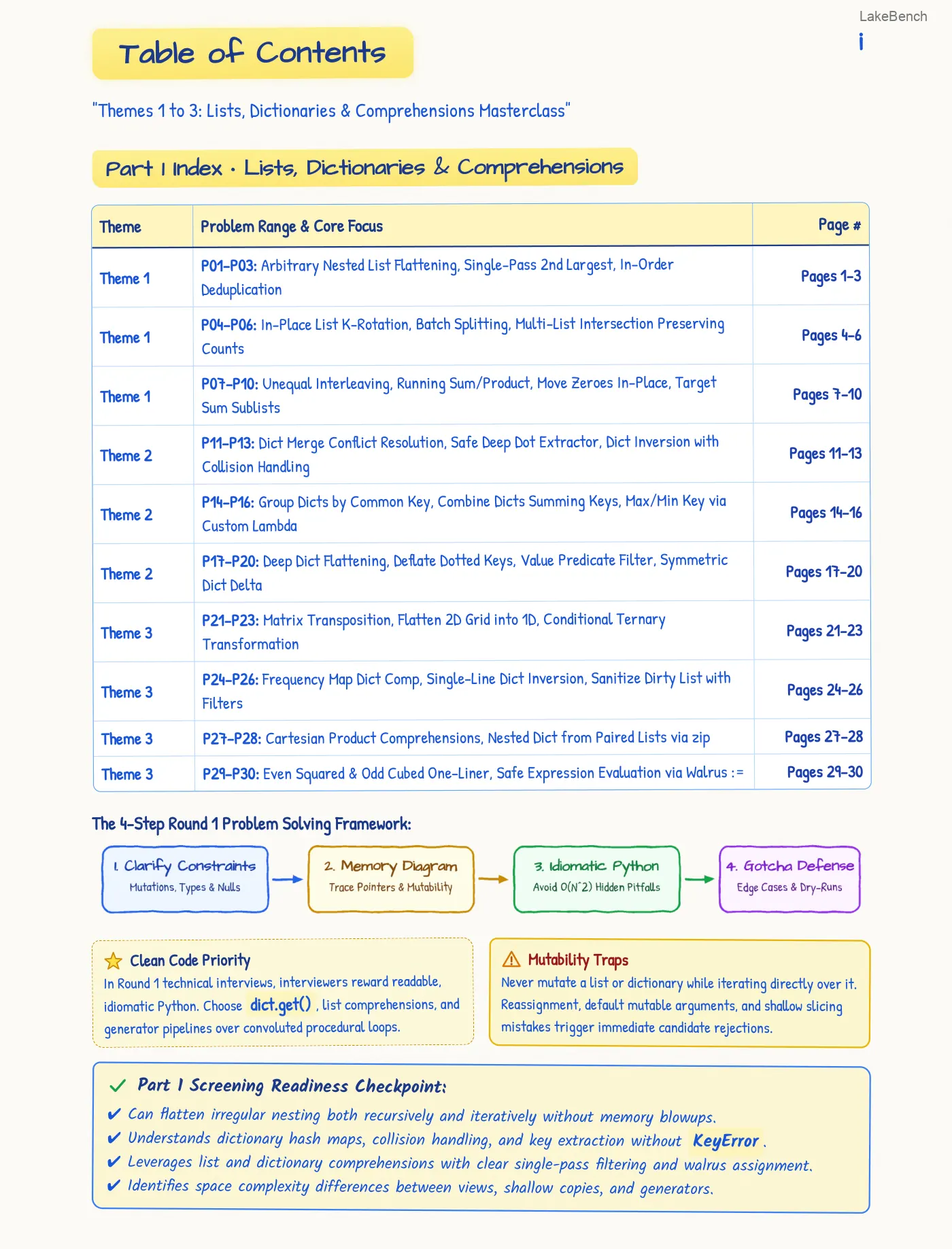
- Recognise the pattern behind a problem: two pointers, window, stack, heap, graph
- Pick the data structure that gives the speed an interviewer asks for
- Walk through trees, graphs, topological order and shortest paths
- Approach backtracking and dynamic programming without panicking
What's inside
Pick a chapter and the notebook opens right there.
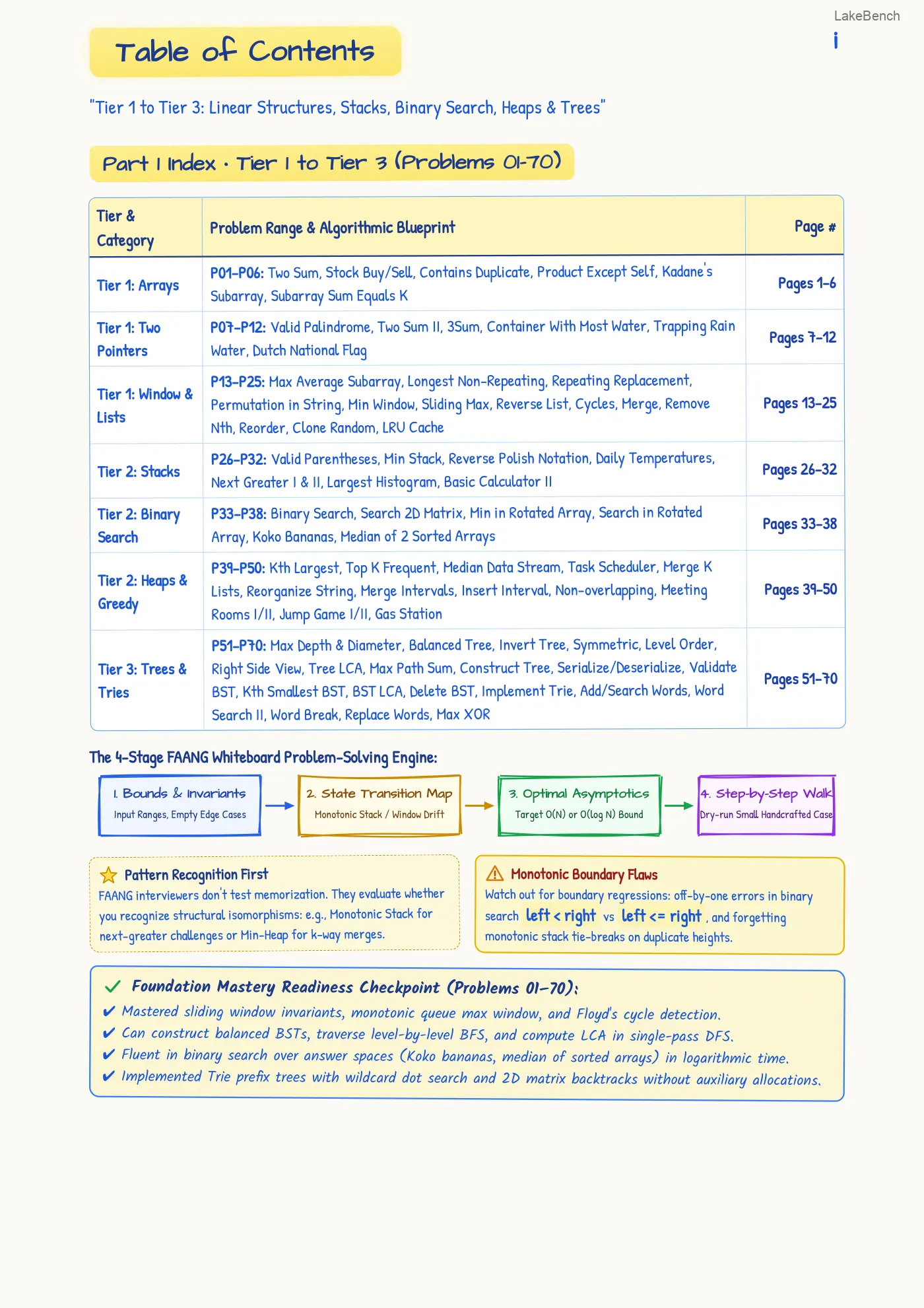
- Tier 1: Arrays · P01–P06Two Sum, Stock Buy/Sell, Contains Duplicate, Product Except Self, Kadane's Subarray, Subarray Sum Equals KStart here
- Tier 1: Two Pointers · P07–P12Valid Palindrome, Two Sum II, 3Sum, Container With Most Water, Trapping Rain Water, Dutch National FlagStart here
- Tier 1: Window & Lists · P13–P25Max Average Subarray, Longest Non-Repeating, Repeating Replacement, Permutation in String, Min Window, Sliding Max, Reverse List, Cycles, Merge, Remove Nth, Reorder, Clone Random, LRU CacheStart here
- Tier 2: Stacks · P26–P32Valid Parentheses, Min Stack, Reverse Polish Notation, Daily Temperatures, Next Greater I & II, Largest Histogram, Basic Calculator IIStart here
- Tier 2: Binary Search · P33–P38Binary Search, Search 2D Matrix, Min in Rotated Array, Search in Rotated Array, Koko Bananas, Median of 2 Sorted ArraysStart here
- Tier 2: Heaps & Greedy · P39–P50Kth Largest, Top K Frequent, Median Data Stream, Task Scheduler, Merge K Lists, Reorganize String, Merge Intervals, Insert Interval, Non-overlapping, Meeting Rooms I/II, Jump Game I/II, Gas StationStart here
- Tier 3: Trees & Tries · P51–P70Max Depth & Diameter, Balanced Tree, Invert Tree, Symmetric, Level Order, Right Side View, Tree LCA, Max Path Sum, Construct Tree, Serialize/Deserialize, Validate BST, Kth Smallest BST, BST LCA, Delete BST, Implement Trie, Add/Search Words, Word Search II, Word Break, Replace Words, Max XORStart here
- Tier 4: Graph Flood · P71–P76Number of Islands, Max Area of Island, Clone Graph, Pacific Atlantic Water Flow, Rotting Oranges, Word LadderStart here
- Tier 4: Topo & DAGs · P77–P80Course Schedule I (Cycle Detection), Course Schedule II (Kahn's BFS), Alien Dictionary, Minimum Height TreesStart here
- Tier 4: DSU & Dijkstra · P81–P85Connected Components, Graph Valid Tree, Redundant Connection, Accounts Merge, Network Delay Time (Dijkstra)Start here
- Tier 5: Backtracking · P86–P90Subsets I & II, Permutations, Combination Sum I & II, Word Search Grid, N- QueensStart here
- Tier 5: 1D DP · P91–P95Climbing Stairs & Min Cost, House Robber I & II, Coin Change, Decode Ways, Longest Increasing Subsequence (LIS)Start here
- Tier 5: 2D & String DP · P96–P100Unique Paths & Min Path Sum, Longest Common Subsequence (LCS), Edit Distance (Levenshtein), Target Sum (0/1 Knapsack), Longest Palindromic SubstringStart here
- Tier 6: Distributed Infra · P101–P104LSM-Trees & Leveled Compaction, Consistent Hashing Ring with Virtual Nodes, Bloom Filter Math & Bit Array, Skip List Probabilistic SearchStart here
- Supplement · P105–P110LFU Cache, KMP String Matching, Fenwick Tree, Reservoir Sampling, HyperLogLog & Count-Min Sketch, External Merge SortStart here
Practice this
Put it to work on LakeBench.
Common questions
- How are the problems ordered?
- They go in tiers, from arrays and two pointers up to graphs and dynamic programming, so each tier builds on the one before it.
- Is it only for FAANG interviews?
- No. The patterns appear in most coding rounds. The later tiers, such as distributed infrastructure problems, go beyond the usual coding round.
- Can I read a sample before I commit?
- Yes. The contents pages and the first pages of every notebook can be read online, so you can judge the style before going further.