Interview
Python Round 1: 60 Core Interview Coding Problems
60 Python coding problems that first-round interviews keep asking, worked step by step.
- Handwritten-style
- Diagrams and tables
- Worked examples
Who this notebook is for
Candidates preparing for the first coding round of a data engineering interview who want to see how a problem is broken down, not only the final answer.
What you will be able to do
- Break a coding question into steps before writing any code
- Recognise which theme a new problem belongs to and reuse the pattern
- Explain your approach clearly, step by step, before you write code
- Move from easier to harder problems theme by theme
What's inside
Pick a chapter and the notebook opens right there.
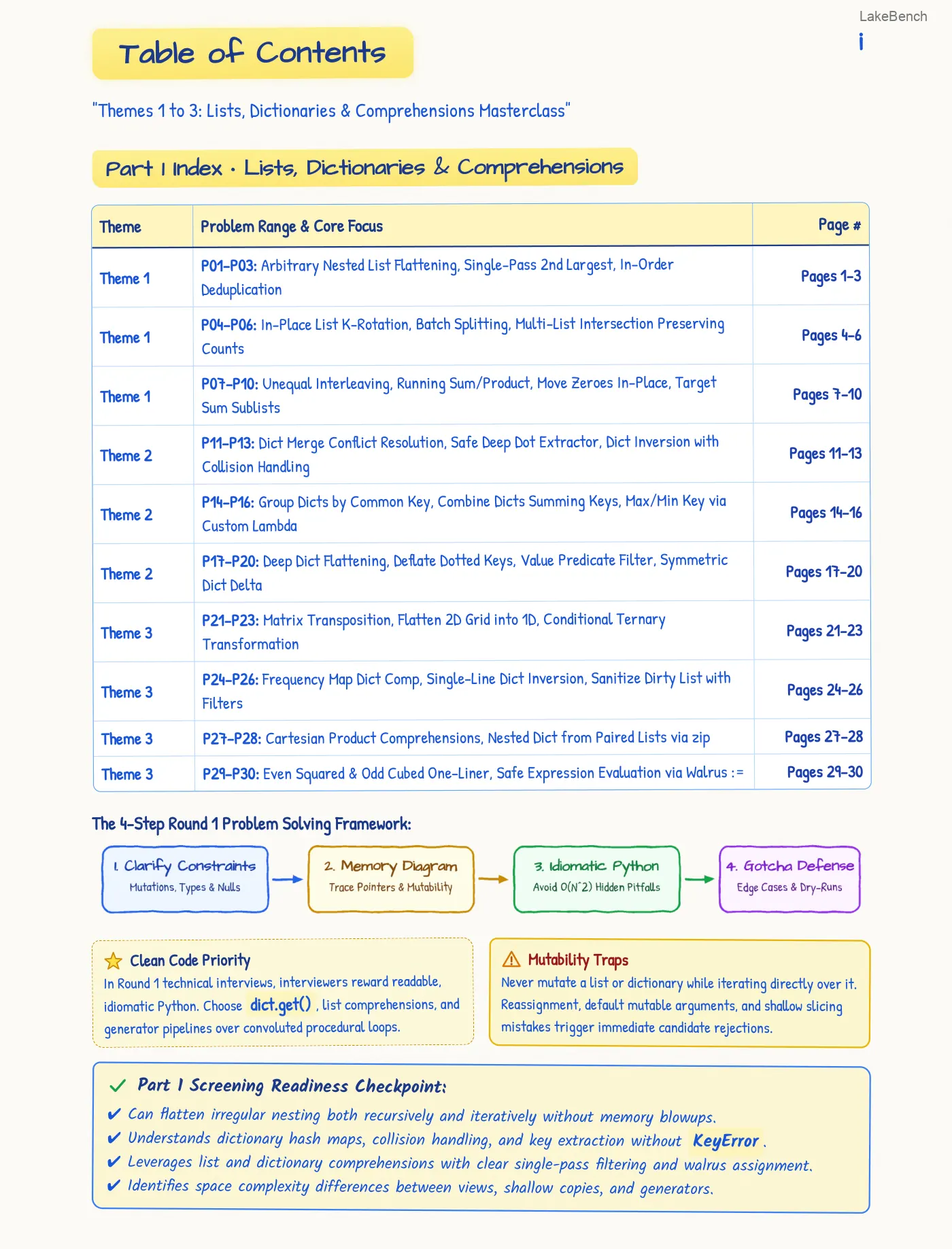
- Theme 1 · P01–P03Arbitrary Nested List Flattening, Single-Pass 2nd Largest, In-Order DeduplicationStart here
- Theme 1 · P04–P06In-Place List K-Rotation, Batch Splitting, Multi-List Intersection Preserving CountsStart here
- Theme 1 · P07–P10Unequal Interleaving, Running Sum/Product, Move Zeroes In-Place, Target Sum SublistsStart here
- Theme 2 · P11–P13Dict Merge Conflict Resolution, Safe Deep Dot Extractor, Dict Inversion with Collision HandlingStart here
- Theme 2 · P14–P16Group Dicts by Common Key, Combine Dicts Summing Keys, Max/Min Key via Custom LambdaStart here
- Theme 2 · P17–P20Deep Dict Flattening, Deflate Dotted Keys, Value Predicate Filter, Symmetric Dict DeltaStart here
- Theme 3 · P21–P23Matrix Transposition, Flatten 2D Grid into 1D, Conditional Ternary TransformationStart here
- Theme 3 · P24–P26Frequency Map Dict Comp, Single-Line Dict Inversion, Sanitize Dirty List with FiltersStart here
- Theme 3 · P27–P28Cartesian Product Comprehensions, Nested Dict from Paired Lists via zipStart here
- Theme 3 · P29–P30Even Squared & Odd Cubed One-Liner, Safe Expression Evaluation via Walrus :=Start here
- Theme 4 · P31–P33Safe Typecasting Helpers, Division with Fallbacks, try-except-else-finally Return TrapsStart here
- Theme 4 · P34–P37Resilient Corrupt List Parsing, Custom Exceptions, Clean Multi-Catch, Exponential Retry WrapperStart here
- Theme 4 · P38–P40Exception Chaining (raise from e), KeyError Prevention Idioms, File try-finally vs withStart here
- Theme 5 · P41–P43Anagram Verification (3 Approaches), First Non-Repeating Character, Normalized Word CounterStart here
- Theme 5 · P44–P46Run-Length String Compression, Safe String Decompression, Alphanumeric Palindrome CheckStart here
- Theme 5 · P47–P50Acronym-Safe Title Casing, Word Reversal Without Slices, Longest Common Prefix, Query String ParserStart here
- Theme 6 · P51–P53Consecutive Grouping with groupby, Target Match Indices via enumerate, Unequal List zip_longestStart here
- Theme 6 · P54–P56collections.Counter Top-K Frequencies, Default Factories with defaultdict, OrderedDict LRU EvictionStart here
- Theme 6 · P57–P58collections.deque Double-Ended Operations, Multi-Key Tuple and Dict SortingStart here
- Theme 6 · P59–P60Safe Dictionary Deletion During Iteration, Memory-Efficient range() vs List BenchmarkStart here
- Theme 7 · P61–P64Token Bucket Limiter, Producer-Consumer Poison Pill, Full Jitter Retry, 50GB Chunk StreamStart here
- Theme 8 · P65–P68Streaming CSV to JSONL Cleaner, bisect & Interval Merge, Frozen Dataclass + pytest, Time-Zone Safe TimestampsStart here
Practice this
Put it to work on LakeBench.
Read the guide first
Short explainers that pair with this notebook.
Common questions
- How are the problems organised?
- They are grouped into themes, and each page works a few related problems from first idea to final code. That way you learn the pattern, not one isolated answer.
- Should I read the Python Simplified notebook first?
- If loops, dictionaries and functions still feel new, start with the Python notebook. If you already write Python comfortably, you can begin here.
- Can I read a sample before I commit?
- Yes. The contents pages and the first pages of every notebook can be read online, so you can judge the style before going further.