
pandasintermediate40 minPandas
Runtime Schema Contract & Column Type Assertion Gate
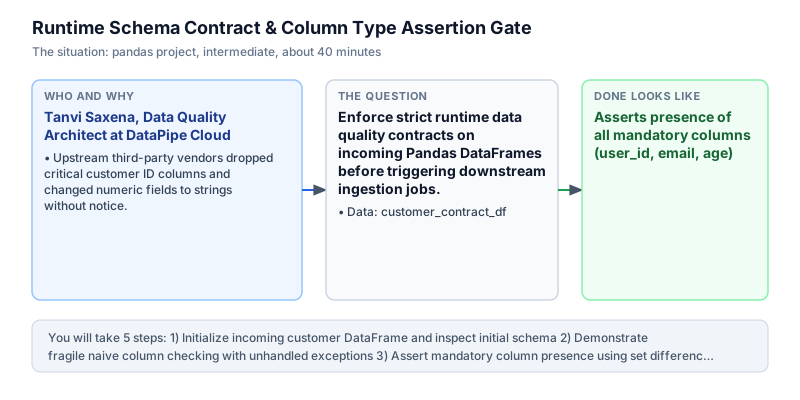
Enforce strict runtime data quality contracts on incoming Pandas DataFrames before triggering downstream ingestion jobs.
The incident
- Company
- DataPipe Cloud
- Engineer
- Tanvi Saxena, Data Quality Architect
- Trigger
- Upstream third-party vendors dropped critical customer ID columns and changed numeric fields to strings without notice.
- Stakes
- Downstream cloud warehouse tables were silently corrupted with NULL keys, breaking reporting for 200 business analysts.
On a Wednesday morning, Tanvi Saxena was alerted by the commercial business intelligence team at DataPipe Cloud, an enterprise analytics platform aggregating multi-channel merchant data. The daily customer revenue dashboards were displaying zero active purchases across all commercial partner segments. Upon querying the underlying production warehouse, Tanvi discovered that over 50,000 customer transaction records had been loaded with null user identifiers, silently corrupting customer relationship records and breaking automated financial attribution models. Because customer relationship management systems depend on persistent user keys to map account behaviors, null key values directly distorted customer lifetime value calculations and executive funnel summaries.
Tanvi traced the failure back to an overnight software release deployed by an external partner vendor. The vendor had unilaterally modified their CSV export schema: they renamed the primary key column from 'user_id' to 'client_identifier' and converted customer age values from integer numbers to unquoted text strings. Because the existing ingestion pipeline had no automated schema validation, Pandas loaded the file without warning, created null-filled fields, and ingested corrupted records directly into production tables. External vendor schema drift is one of the most common causes of data outages in modern data platforms, occurring whenever upstream software engineers release updates without coordinating downstream API contracts.
The downstream impact was severe. Over 200 commercial business analysts were blocked for more than four hours while engineering teams initiated emergency database restores from point-in-time snapshots. The incident exposed a critical operational vulnerability: ingestion pipelines lacked a fail-fast runtime quality contract to intercept and reject structural schema drift before committing writes to production storage layers. Business stakeholders lost confidence in automated morning metric deliveries, forcing senior engineering leadership to commit significant incident remediation time to manual database repairs.
Tanvi set out to design a shift-left runtime data quality gate in Pandas. The gate needed to enforce a strict contract covering both structural column presence and semantic data types. If an upstream producer dropped mandatory fields or altered column types, the validation gate had to halt execution immediately with actionable diagnostic error messages, preventing corrupted payloads from ever reaching downstream warehouse sinks and halting pipeline runs cleanly. Establishing shift-left quality contracts ensures that pipeline failures happen predictably and gracefully at the outer ingestion boundary rather than deep within analytical warehouse tables.
Tanvi engineered a reusable validation function leveraging Python set difference operations and the Pandas api.types inspection module. By testing column presence against expected schema sets and evaluating column types using is_integer_dtype and is_string_dtype, the validation gate guarantees structural integrity without depending on fragile string type name comparisons that fail across modern PyArrow backends.
Tanvi integrated the schema assertion gate as a mandatory pre-condition in the DataPipe Cloud ingestion orchestrator. When tested against non-compliant files, the gate caught schema mismatches with clear descriptive errors, while cleanly approving valid customer batches. Enforcing automated runtime contracts protected production tables from silent corruption, securing analytical reporting for 200 analysts and establishing reliable quality boundaries across all partner feeds.
What you will learn
- Define strict schema contracts mapping expected column names to data types
- Validate column presence using set difference operations in Python
- Verify column data types robustly using pd.api.types inspection helpers
- Implement fail-fast data quality gates to protect production data warehouses
What you need first
Schema ContractsData quality testing strategies
A data contract specifies structural column expectations and data types that incoming datasets must satisfy before ingestion.
expected = {'id', 'val'}
actual = {'id'}
print(expected - actual){'val'}Relying on implicit downstream errors rather than checking explicit column sets at the ingestion boundary.
Pandas API Type InspectionPandas Series and DataFrame
pd.api.types provides robust functions like is_integer_dtype and is_string_dtype that work across all Pandas backend representations.
import pandas as pd
s = pd.Series([1, 2, 3])
print(pd.api.types.is_integer_dtype(s))True
Checking dtype == 'object' for strings, which breaks when modern PyArrow string or nullable string types are used.
Architecture and data flow
The data
A customer profile DataFrame with user_id, email, and age columns to be tested against a schema contract.
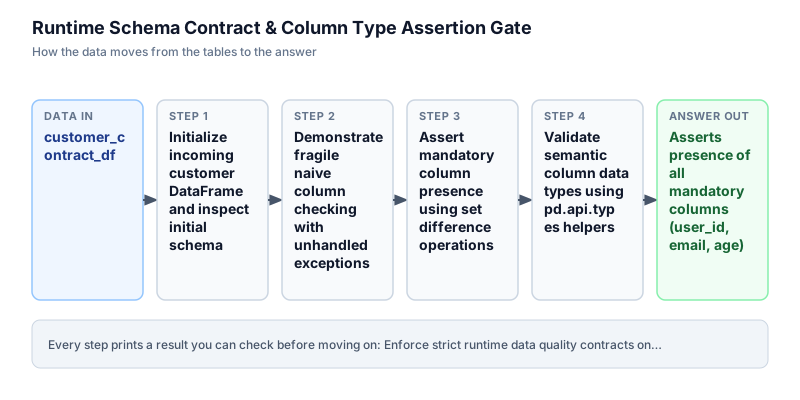
customer_contract_df: Incoming customer profile dataset
| user_id | age | |
|---|---|---|
| 1 | [email protected] | 25 |
| 2 | [email protected] | 30 |
| 3 | [email protected] | 22 |
Step by step
Read each step, run its code, then check your output against the one shown.
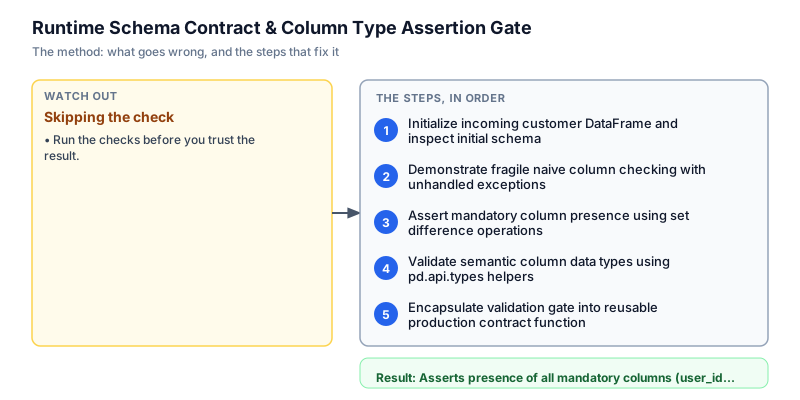
Initialize incoming customer DataFrame and inspect initial schema
We initialize a representative customer profile DataFrame containing three records with user_id, email, and age columns. In production ingestion systems, incoming partner feeds arrive as untrusted tabular payloads that may conform to expectations or suffer from upstream schema drift. We display the DataFrame length and column list to verify the baseline schema structure before applying automated contract validation rules. Verifying the initial column list establishes an empirical foundation for structural comparison against downstream schema requirements and table specifications. Establishing a baseline inspection step guarantees that pipeline engineers can observe raw input structure prior to enforcement.
import pandas as pd df = pd.DataFrame({ "user_id": [1, 2, 3], "email": ["[email protected]", "[email protected]", "[email protected]"], "age": [25, 30, 22] }) print("Incoming DataFrame rows:", len(df)) print("Incoming columns:", list(df.columns))Incoming DataFrame rows: 3 Incoming columns: ['user_id', 'email', 'age']
Common mistakeAssuming incoming third-party CSV files will always match expected production schemas without runtime verification.
How you will knowYou will see 3 incoming rows and columns matching user_id, email, and age.
Demonstrate fragile naive column checking with unhandled exceptions
Wrong turn first: this step shows the mistake before the fix
Here is the naive approach developers often attempt first: directly indexing expected columns or comparing dtype string names like df['client_id'].dtype == 'int64'. If an upstream producer renames or drops a column, directly accessing df['client_id'] raises an unhandled KeyError that crashes the entire pipeline execution without. We execute this naive check inside a try-except block to demonstrate why presence verification must precede type inspection and why unhandled exceptions damage pipeline observability across enterprise ingestion frameworks. Handling schema mismatches through structured contracts prevents abrupt execution crashes and improves operational telemetry.
import pandas as pd df = pd.DataFrame({ "user_id": [1, 2, 3], "email": ["[email protected]", "[email protected]", "[email protected]"], "age": [25, 30, 22] }) try: is_client_id = df["client_id"].dtype == "int64" print("Direct check:", is_client_id) except Exception as e: print("Naive check failed with unhandled exception:", type(e).__name__)Naive check failed with unhandled exception: KeyError
Common mistakeDirectly accessing columns before checking presence, triggering unhandled KeyError exceptions that crash pipelines.
How you will knowObserve that direct indexing raises an unhandled KeyError when a column is missing.
Assert mandatory column presence using set difference operations
To avoid unhandled KeyError exceptions, we verify column presence using Python mathematical set difference. We define expected_cols as a set containing 'user_id', 'email', and 'age'. Subtracting set(df.columns) from expected_cols isolates any missing fields in one pass over the column names. If the difference set is empty, all required columns exist. If fields are missing, the difference set provides an exact list of missing attributes for diagnostic logging and alerts. Set difference calculations offer an elegant, high-performance mechanism for validating schema completeness across large production tables.
import pandas as pd df = pd.DataFrame({ "user_id": [1, 2, 3], "email": ["[email protected]", "[email protected]", "[email protected]"], "age": [25, 30, 22] }) expected_cols = {"user_id", "email", "age"} missing = expected_cols - set(df.columns) print("Missing columns:", missing) print("Has all required columns:", len(missing) == 0)Missing columns: set() Has all required columns: True
Common mistakeUsing nested list iteration instead of set differences for column presence checks, leading to O(n*m) complexity.
How you will knowOutput shows Missing columns: set() and Has all required columns: True.
Validate semantic column data types using pd.api.types helpers
Once column presence is verified, we validate semantic data types using the official Pandas type inspection module: pd.api.types. Rather than performing fragile string comparisons like dtype == 'int64', functions like is_integer_dtype and is_string_dtype correctly recognize integer and string representations across standard numpy types, nullable integer types (Int64), and modern PyArrow string backends. We verify that user_id and age are valid integers and email is a valid string. Using official type inspection helpers avoids brittle string comparisons that fail when library versions update.
import pandas as pd df = pd.DataFrame({ "user_id": [1, 2, 3], "email": ["[email protected]", "[email protected]", "[email protected]"], "age": [25, 30, 22] }) print("user_id is integer:", pd.api.types.is_integer_dtype(df["user_id"])) print("email is string:", pd.api.types.is_string_dtype(df["email"])) print("age is integer:", pd.api.types.is_integer_dtype(df["age"]))user_id is integer: True email is string: True age is integer: True
Common mistakeChecking dtype == 'object' for strings, which breaks when DataFrames use modern PyArrow or StringDtype representations.
How you will knowOutput prints True for each of the three type assertions.
Encapsulate validation gate into reusable production contract function
In the final step, we encapsulate structural presence checks and type assertions into a reusable production contract validator function: validate_contract. The function returns a boolean success status alongside a human-readable diagnostic message. When tested against our valid customer dataset, it returns True with 'All contract assertions passed'. If tested against a drifted payload, it halts execution before database writes occur. Reusable validation functions standardize quality enforcement across multiple ingestion workflows and third-party data feeds.
import pandas as pd df = pd.DataFrame({ "user_id": [1, 2, 3], "email": ["[email protected]", "[email protected]", "[email protected]"], "age": [25, 30, 22] }) def validate_contract(dataframe): expected_cols = {"user_id", "email", "age"} missing = expected_cols - set(dataframe.columns) if missing: return False, f"Missing columns: {sorted(list(missing))}" if not pd.api.types.is_integer_dtype(dataframe["user_id"]): return False, "user_id must be integer" if not pd.api.types.is_string_dtype(dataframe["email"]): return False, "email must be string" if not pd.api.types.is_integer_dtype(dataframe["age"]): return False, "age must be integer" return True, "All contract assertions passed" is_valid, msg = validate_contract(df) print("Contract Valid:", is_valid) print("Status:", msg)Contract Valid: True Status: All contract assertions passed
Common mistakeFailing to return structured status tuples or exceptions, causing callers to proceed with ingestion despite validation failures.
How you will knowOutput prints Contract Valid: True and Status: All contract assertions passed.
Build it yourself
Write your solution below, run it in your browser, and pass every check.
What the result means
Interpretation
Implementing an automated runtime contract validation gate prevents silent schema drift and column omission defects at the ingestion boundary. By verifying structural column presence with set differences and inspecting column types using pd.api.types, the gate halts corrupted payloads with clear diagnostic feedback before database writes occur.
The message you would send
Data quality contract enforcement complete: we integrated automated runtime schema assertions on all customer profile feeds. Incoming batches are strictly validated for mandatory column presence (user_id, email, age) and data types prior to ingestion. This gate prevents silent table corruption, securing data integrity for over 200 analytical dashboards.
Put it on your CV
Resume or LinkedIn bullet
Architected shift-left runtime schema assertion frameworks in Pandas preventing data corruption across production warehouse tables.README for GitHub
# Runtime Schema Contract & Column Type Assertion Gate in Pandas

Engineered an automated runtime data contract validation gate in Pandas. Replaced silent pipeline failures with strict fail-fast structural and type assertions.

## Technical Details
- Engine: Python 3 / Pandas
- Type Inspection: pd.api.types.is_integer_dtype, pd.api.types.is_string_dtype
- Integrity: Set-difference column verification preventing silent column omissions.

## Results
- Prevented silent warehouse table corruption, securing data integrity for over 200 analytics dashboards.Extend the contract to enforce nullability checks (e.g. assert dataframe['user_id'].notnull().all()).